
Photography courtesy of Lowell Washburn, all rights reserved.
October 2023 — Following a long and frantic search – a search in which everything I owned had been turned upside down — I had failed to find my missing decoy. This was no ordinary decoy, mind you, but one of a set nine beautiful canvasback drakes hand crafted by legendary Mississippi River waterfowler, Ralph Thomson. My son Matt had discovered the effigies while purchasing a rig of Thomson mallard decoys in 2000. Matt gave me call, saying the ‘cans were up for grabs, noting that Thomson said they would be the last he would ever make or offer for sale. I naturally jumped at the opportunity to possess these unique pieces of the Mississippi’s waterfowling history.
For the next twenty some years, the Thomson canvasbacks became a standard feature of our diver rig. Whenever and wherever we hunted the open waters, the ‘Ralphies’ were there. Although hard use had produced some paint chips here and there, the decoys had adequately withstood the test of time, even to the point of surviving the ice and white-capped waters of late season winter storm fronts and had borne witness to the wild, eye popping migrations that accompanied such storms. And then, as suddenly as the set had come into my life, one of its members had vanished. After months of looking and hoping, I finally had to concede that the decoy was gone forever.
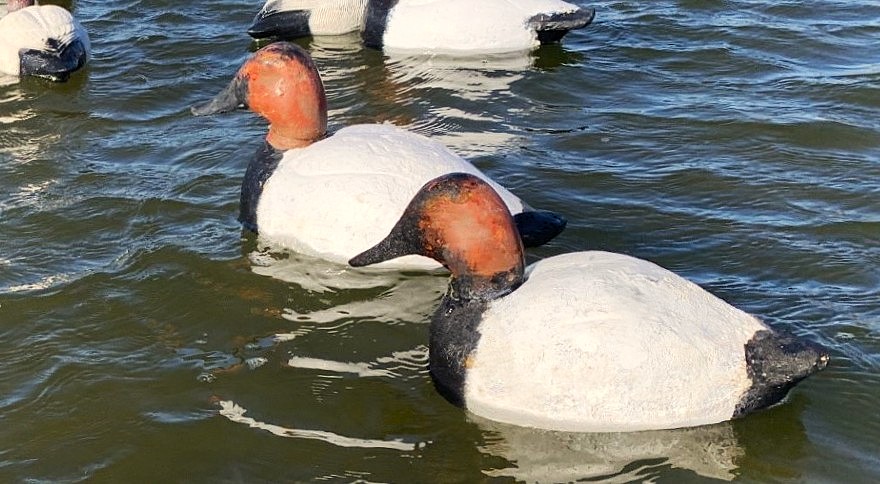
September 2025 – At the conclusion of a September teal hunt on northern Iowa’s Union Hills Wildlife Area, I was making my way back to the truck when something beneath the tall prairie grasses caught my my attention. Wresting the object from the firm grip of bluestem and wild aster, I could scarcely believe my eyes. Low and behold, it was my long lost decoy! Mystery solved; the block had apparently slipped from the bag during a year’s earlier, late season outing. The fact that I had stumbled upon the decoy while walking through a sprawling, 2,000 plus acre, public wetland complex seemed a miracle.
But all was not well. The decoy was in sad shape. Sitting through seasons of ice, snow, rain and wind had probably had little effect on the lost decoy. But when a prescribed burn rolled across the prairie landscape, the decoy was unable to cope. The result was not pretty. Burned almost beyond recognition, the ‘can was charred and disfigured. The only thing remaining unscathed was the lead strap anchor still wrapped around the old decoy’s neck.

Under normal circumstances, the decoy would have been discarded. But due to its unique history, I decided to attempt a restoration. Although enough of the decoy had been burned away that it could never regain its original shape, some vigorous filing did manage to improve its misshapen form. A fresh coat of paint brought the effigy back to life. Although far from perfect, the decoy appeared ready to resume active duty. The lengthy hiatus finally ended when, late last week, the restored decoy rejoined his rig mates on the November waters. And as I was about to learn, the Ralphie’s debut outing could not have been more dramatic.
The stars had faded and the eastern horizon was ablaze with color when, etched as black silhouettes against the predawn sky, a trio of canvasback ducks made their appearance. Hard to say, but the migrators may have been traveling all night. What I do know for sure is that, upon spotting the decoys, the ‘cans hit the brakes and began losing altitude. Circling the rig, the ducks piled in on their third low level pass.
The scene was as breathtakingly beautiful as it was rare. Although we always set for canvasbacks when hunting the open waters, most of the diving ducks we actually bring to bag are other species – redheads, bluebills, ring-necks, goldeneyes, etc. Although these ducks are always welcome, the regal canvasback is in a class of its own. Canvasback ducks are simply the crown jewels – the crème de la crème — of American waterfowling. To have the King of Ducks visit your well placed spread of decoys represents the high water mark of duck hunting. Nothing else compares. Never has. Never will. The idea that a trio of canvasbacks would be the very first ducks to sail in to that recommissioned old decoy simply defied all odds.
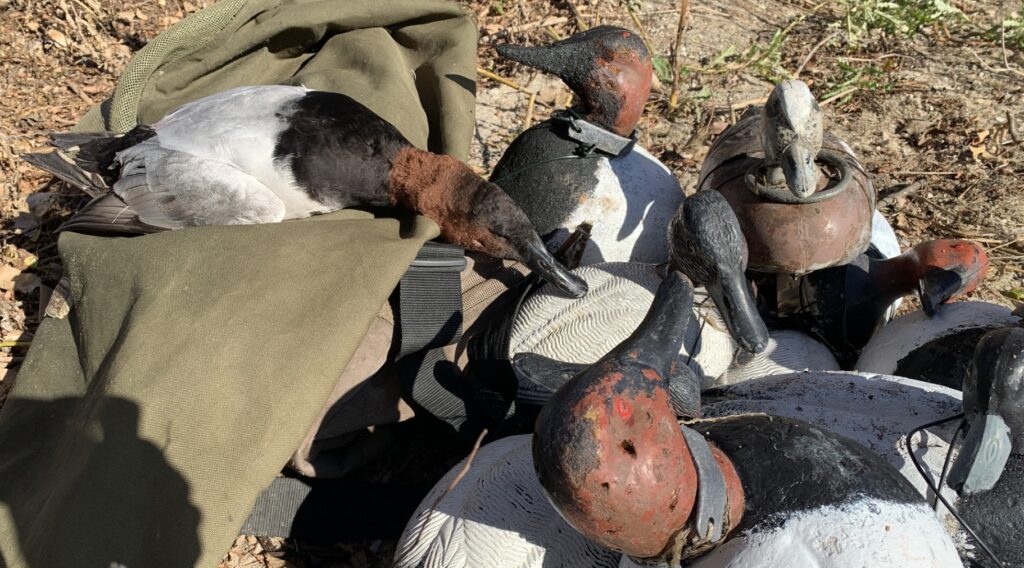
Raising the shotgun, I downed a drake with the first barrel, and then cleanly missed with the second. Considering my current state of excitement, I felt fortunate to have hit anything at all. Despite the miss, I was elated. The downed canvasback was heavy, fat, and colorful. Even if I never saw so much a single duck during the remainder of the morning, the day would be remembered as a stellar outing. As I returned my attention to the decoys, I’m pretty sure that I saw the old ‘Ralphie’ display a brief smile.
 Susan Judkins Josten
 Rudi Roeslein
 Elyssa McFarland
 Mark Langgin
 Adam Janke
 Joe Henry
 Sue Wilkinson
 Tom Cope
 Kristin Ashenbrenner
 Joe Wilkinson
 Dr. Tammy Mildenstein
 Sean McMahon