Photography courtesy of Lowell Washburn, all rights reserved.
Commonly referred to as The Sport of Kings, falconry is defined as the pursuit of wild game with trained raptors. Regardless of whether your protege is a red-tailed hawk, goshawk, or peregrine falcon, training a wild bird-of-prey to accept you as an equal and trusted hunting partner is a step by step process with each bird having its own unique personality and providing its own set of challenges.
Training a bird for falconry has two major milestones. The first is having your bird return following its first free flight. The second is the day you take your first head of wild game, a noteworthy event that helps cement the bond between you and your hawk. In most cases, the first successful hunt is a joyous event that results in bringing home a rabbit, pheasant, or wild duck.
There are exceptions, of course. One of my most memorable occurred three winters ago while training a young-of-the-year, female peregrine that I was trying to make into a pheasant hawk. Strong and in superb condition, the young falcon was flying great. But she had not yet learned to stay in position, remaining high overhead while I attempted to locate and flush the quarry. Instead the bird loved to wander far and wide. Although she was providing some spectacular observations, her current style was not conducive to bagging wild pheasants. Once the crouching birds determined that the falcon had drifted far enough away to where they couldn’t be caught, the pheasants would blow for the nearest heavy cover. The peregrine would immediately give chase but, in just the nick of time, the birds would reach their destination and disappear into thick vegetation. This happened time and again until, one day, the tables turned.
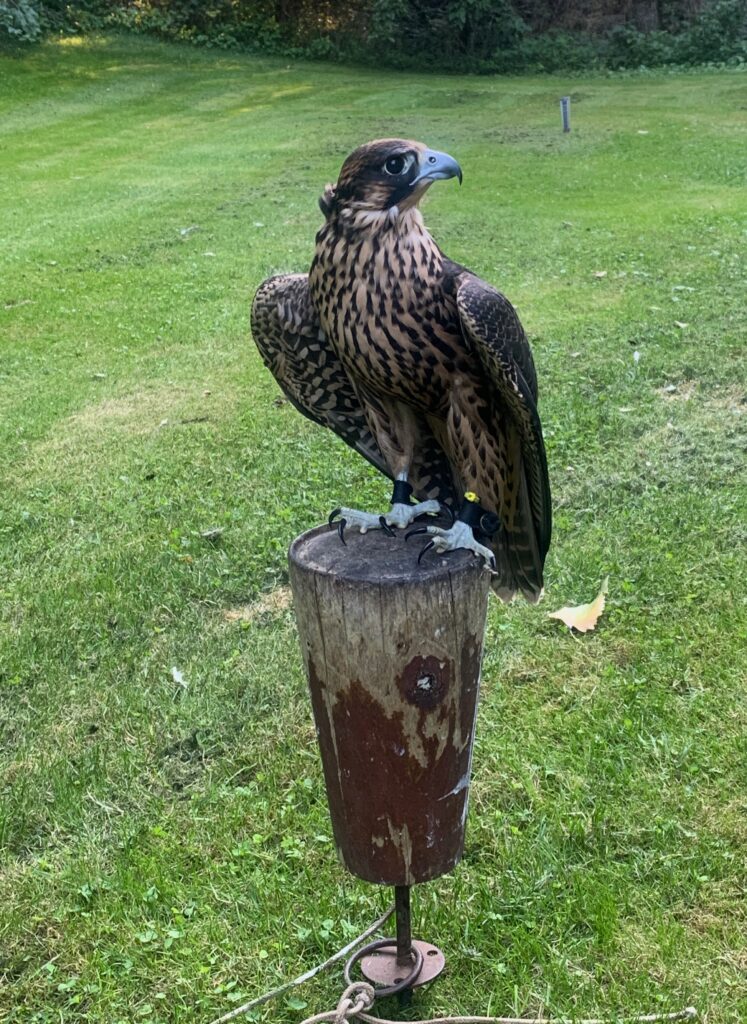
While driving down a gravel road south of Ventura [Cerro Gordo County], I spotted a pair of roosters sitting in a snowy fenceline on the Dean Josten farm where I had permission to hunt. Not wanting to spook the pheasants prematurely, I drove further down the road until I was out of sight. After releasing the falcon, she began her usual routine of wandering the sky. When she finally headed back in my direction, I began a cautious approach toward the fence. The roosters stayed put and it appeared as if this might finally be the flight we had been waiting for. Before long, the pinned pheasants could not only see the approaching falcon, but could also see me as well. Aware of the developing situation, one of the roosters lost his nerve and launched into the air. The peregrine immediately gave chase, coming across the winter sky in a long, slanting dive.
It quickly became apparent where the rooster was headed – a thick stand of cover located to the side of Dean’s farmstead. As the flight progressed, it quickly developed into a spectacular high-speed, high-stakes, all for nothing chase with each bird flying as hard as it could go. The peregrine had began closing the gap, and it was going to be another too-close-to-call, photo finish contest. The speeding rooster appeared to agree with this assessment. With its destination nearly a hundred yards distant, the pheasant began rapidly losing altitude while looking for an alternate plan. Within seconds, both birds disappeared into the building site with the peregrine still hot on the rooster’s tail.
This was not good. With a lengthy list of potential dangers – including power poles, cats, dogs, and other hazards – rural building sites are not a safe place for hawks to sit. Heading back for the vehicle, I sprinted until running out of breath and was forced to slow to a walk. Finally reaching the Suburban, I sped for the farmstead. My falcon was outfitted with an electronic locator. Upon reaching the building site, I looked down to switch on the telemetry receiver. In the second it took to do that, my front wheel slipped off the edge of the gravel. The rear wheel followed, and I ended up with my truck frame high centered on the edge of the roadbed. Just a few yards from Dean’s driveway, I was hopelessly stuck.
But I could worry about the truck later. Right now, I needed to find my falcon – hopefully sitting nearby, alive and well. While struggling to exit my tilted vehicle, I must have bumped the lock. And as gravity swung the door shut, I could heard the sickening sound of all four doors locking behind me. Worst of all, the telemetry set that I needed to locate the hawk was still lying on the seat behind those locked doors.
My afternoon adventure was no longer feeling like the Sport of Kings.
In a growing state of panic, I began running around the buildings looking for any sign of the hawk. There wasn’t any, and I began to wonder if the pheasant had made it to cover and if my bird had kept on rocketing to who knows where. She was, after all, still in the early stages of training. I had to get into that truck.
No one was home at the farm, and I began searching for a heavy piece of wire with which to burglarize my vehicle. I found a suitable piece, and with some effort managed to free one of the locks without breaking any windows. Grabbing the telemetry, I was thrilled to receive a strong signal issuing from somewhere within the immediate building site. As I followed the ever strengthening beeps, my ongoing progress was monitored by three or four friendly cats. I wondered if the cats had seen two speeding birds pass by.
Upon rounding the corner of a steel building some minutes later, I was greeted by the sight of a rolling procession of brightly colored, wind driven pheasant feathers. Although the telemetry was really pounding now, the electronics were no longer needed. I simply followed the feather trail to where, concealed behind a huge snow drift, my precious peregrine was standing atop a recently deceased, long tailed rooster. Praise God!
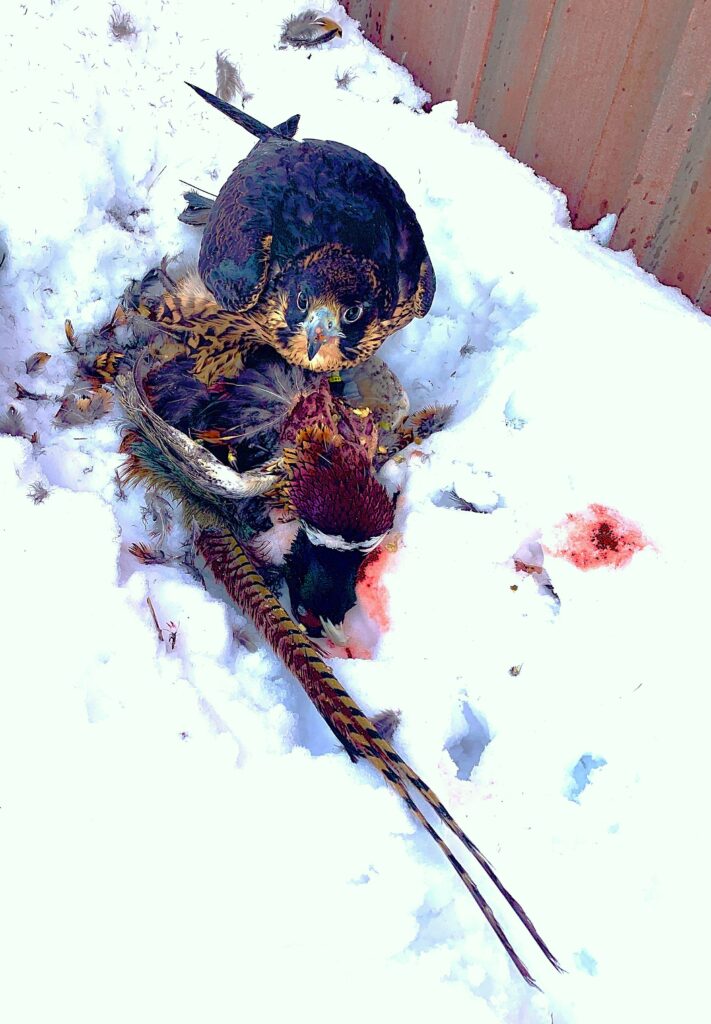
Still out of breath and sweaty, I was completely frazzled. By contrast, the falcon was calm and collected; looking up at me as if to say, “What took you so long?”
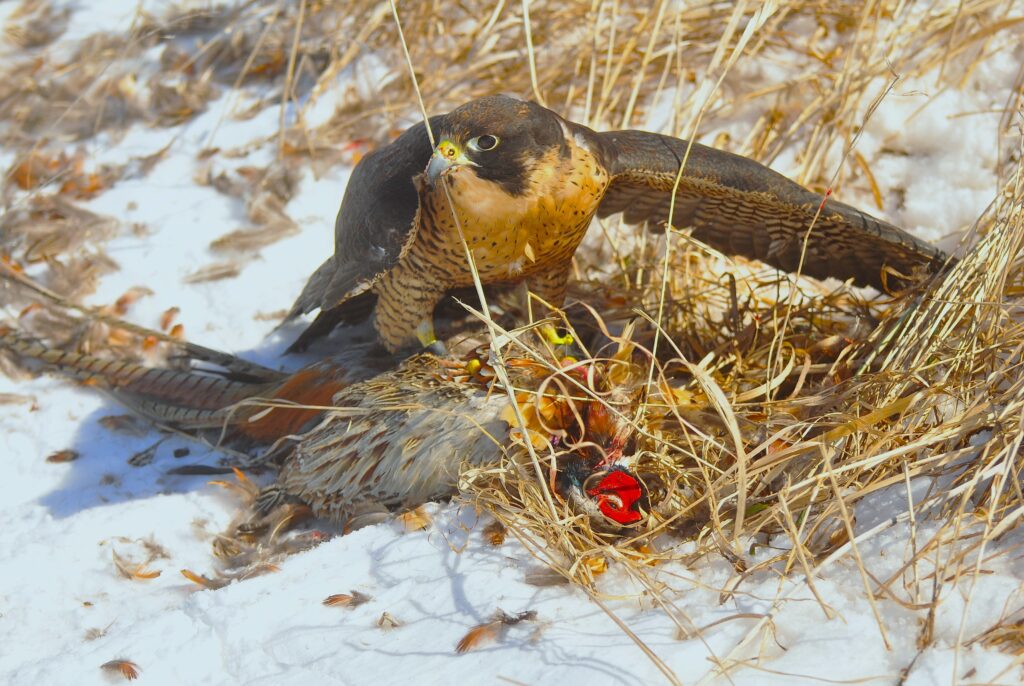
Because of my lengthy delay, the hawk had eaten more of the pheasant that I would normally permit. But in this case, I didn’t care – she was welcome to my portion too. It had been a hair raising flight and she had earned the meal. I was just thrilled over her safe recovery.
Dean returned home about the time I was getting back to the truck. Driving a tractor from the machine shed, he had my vehicle back on the road in seconds. In more than forty years of falconry, this remains the most harrowing, first successful flight that I’ve ever had.
Now in her third winter, the peregrine has become a confident hunter and a loyal partner. A joy to fly, I love her dearly. Once again, falconry is feeling like the Sport of Kings.
 Ann Wolf
 Thomas Rinehart
 Susan Judkins Josten
 Rudi Roeslein
 Elyssa McFarland
 Mark Langgin
 Adam Janke
 Joe Henry
 Sue Wilkinson
 Tom Cope
 Kristin Ashenbrenner
 Joe Wilkinson
 Dr. Tammy Mildenstein
 Sean McMahon