Photography courtesy of Lowell Washburn, all rights reserved.
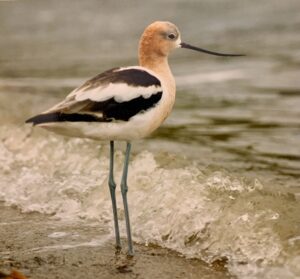
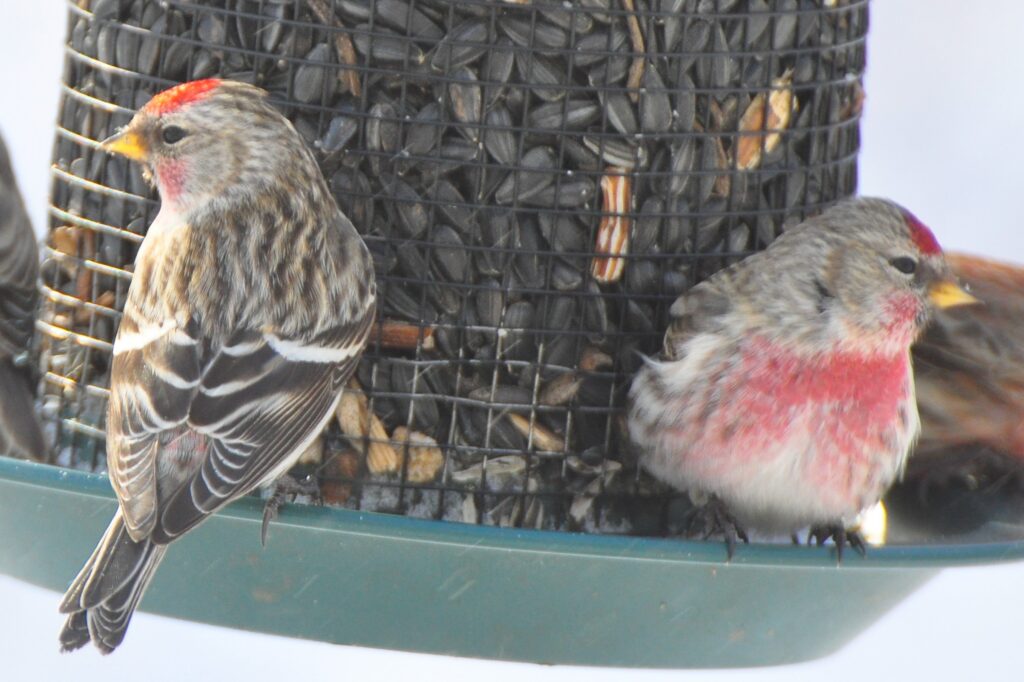
Most birding enthusiasts, myself included, are always on the lookout for something rare or unusual – a visiting species that normally doesn’t occur in our area. I’ve been treated to several sightings that fall into this category. The majority of these feathered travelers have been officially listed by the Iowa Ornithologists Union [IOU] as ‘rare or uncommon winter visitors to Iowa’. Most encounters have taken place close to my Clear Lake home. The roster of these out of the ordinary visitors include more than a dozen species – Louisiana waterthrush, American avocets, godwits, black-necked stilts, Carolina and winter wrens, red-shafted flickers, snowy owls, red-breasted nuthatches, a black-headed grosbeak, red crossbill, black-bellied plovers, two gyrfalcons, and two great gray owls.

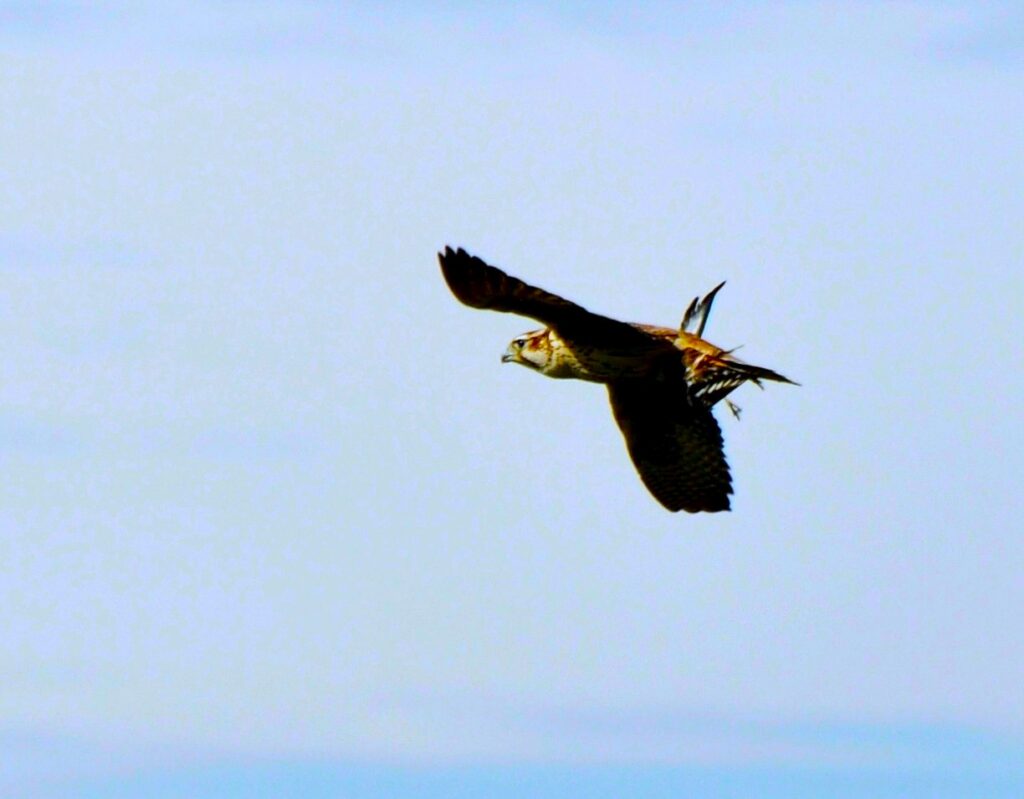
Some sightings are more spectacular than others. One my most memorable occurred while photographing shorebirds on the fringe of a mudflat near Cerro Gordo County’s Mallard Marsh. The fall migration was at its peak and business was brisk. All was calm until the feeding shorebirds – hundreds of them – suddenly erupted in complete panic. I quickly spotted the source of the chaos – an incoming prairie falcon – a western cousin of the peregrine — was hunting for its breakfast. Picking its target, the falcon put on a quick burst of speed and deftly plucked a fleeing killdeer from the sky. Never missing a wingbeat, the prairie continued on way. As it passed, I was able to snap a couple of photos of the raptor with its prey.
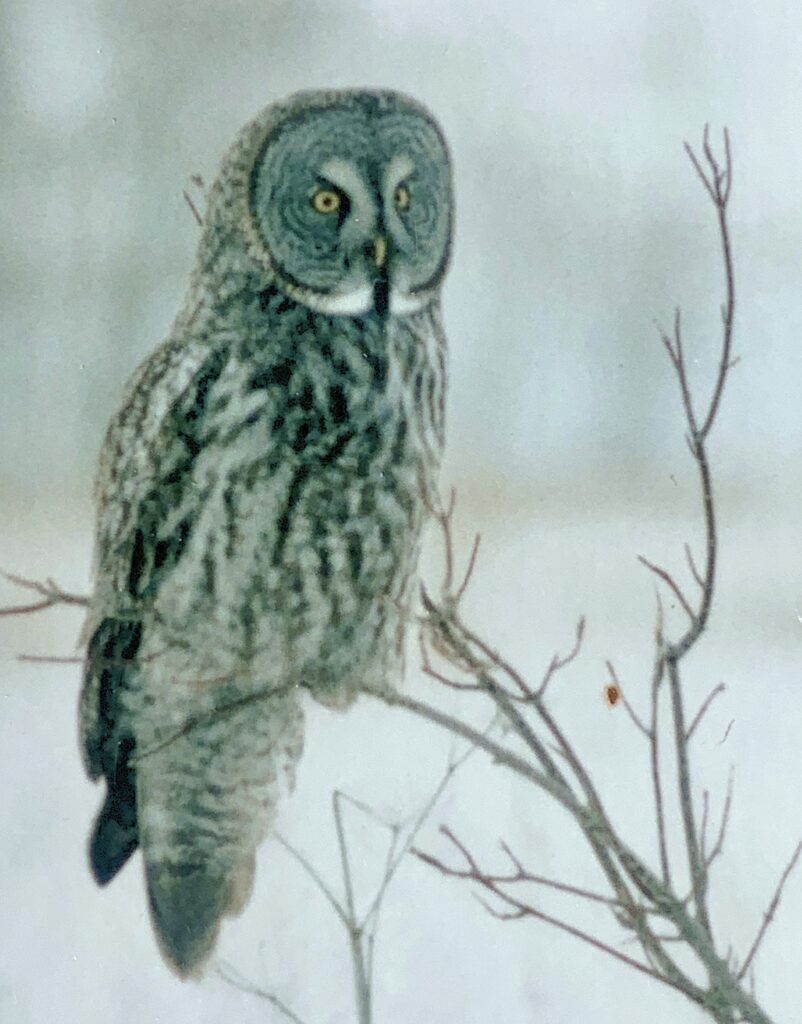
Other sightings have stirred more widespread interest. A classic example occurred in February, 1997 when a pair of great gray owls were spotted at Cerro Gordo County’s Claybanks Forest near Rockford. The great gray is a large and impressive bird of the Far North. Having little, or no, previous human contact, the huge Gray Ghosts were quite approachable. Once the owls were spotted, the rare migrants stayed at the Clay Banks for several days and were viewed by wildlife enthusiasts from across the region.
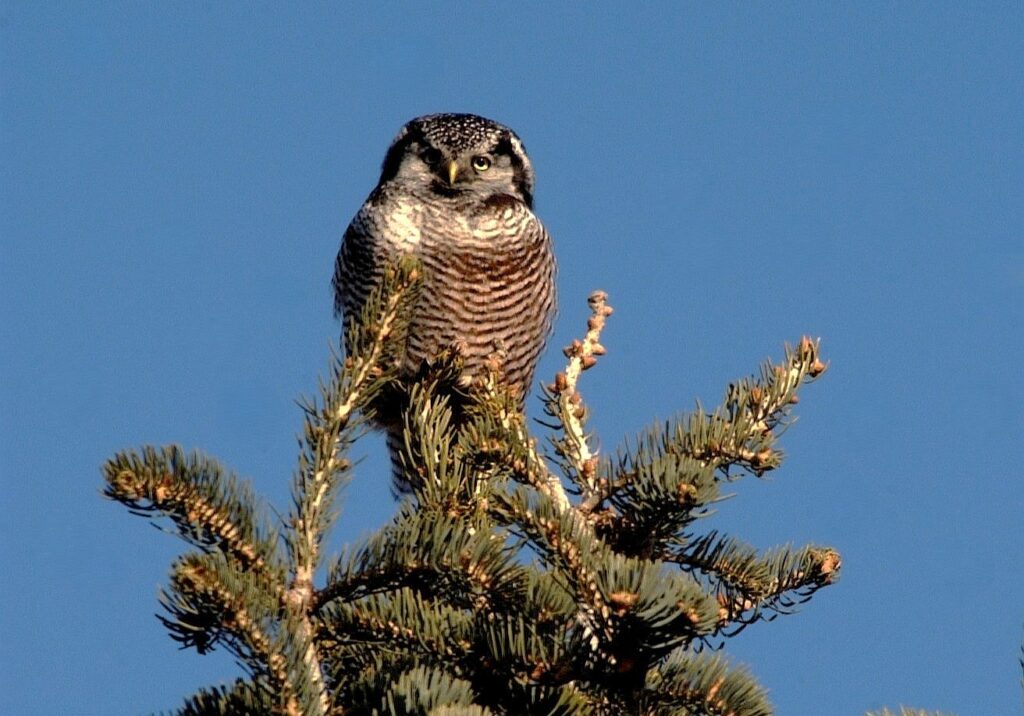
But perhaps no single sighting will ever surpass the excitement generated by the confirmed report of a northern hawk owl temporarily residing in the evergreens of [Worth County’s] Manly, Iowa in the winter of 2005. Official records show that the Manly sighting was only the second time a northern hawk owl has been documented in Iowa – ever! Unlike most rare bird sightings, where an individual is spotted once or twice and then vanishes, the Manly owl was remarkably predictable. Anyone who traveled to view the feathered celebrity was all but guaranteed a sighting. Word spread and it wasn’t long until this rural Iowa community became the hotspot destination for birders from across the state and beyond.
“The excitement this bird generated really was remarkable,” noted Paul Hertzel, a renowned Iowa birder and instructor at Mason City’s North Iowa Area Community College.
“I personally know of people who came here, not only from all points across Iowa, but also from Wisconsin, Nebraska, Missouri, Illinois, and Minnesota. I think the farthest distance was when Paul Lehman [a former editor of Birding Magazine] came here from New Jersey. He was actually on his way to look for cranes in Nebraska. But when he landed in Omaha, he got a car, drove to Manly, observed the hawk owl, and then drove back to Omaha.”
“Part of what made this all possible for so many people was that this bird stayed so faithfully for so long in one little place,” said Hertzel. The final sighting of Manly’s northern hawk owl was on April 2, 2005. From start to finish, the raptor was known to have been in Worth county for exactly 100 days.
By the time I visited Manly, the hawk owl had already been in town for several days. Finding the bird was easy. All a person needed to do was look for a cluster of birders huddled behind tripods bearing spotting scopes or telephoto camera lenses. I joined a group for an hour or so — chatting, comparing notes, and snapping photos as people came and went.
The February weather was crisp that morning and the northwest breeze had a raw edge. I decided to break for coffee. There was a Casey’s located a couple blocks to the west. Walking into the station, I headed for the restroom. No deal. A line of nine fidgeting people were waiting ahead of me.
Oh well. I decided to grab that cup of hot coffee while I waited. No deal. All four pots were completely dry.
“Ah, did you know that you’re out of coffee,” I asked the clerk at the counter.
“Yes,” replied the obviously frustrated attendant. “And it’s all because of that bird. It’s been this way all week. Mornings are the worst, and we just can’t keep up. I’ve never seen anything like it. People are driving from all over the place just to look at a bird.”
“Can you imagine?,” she asked.
 Craig Parker
 Ann Wolf
 Thomas Rinehart
 Susan Judkins Josten
 Rudi Roeslein
 Elyssa McFarland
 Mark Langgin
 Adam Janke
 Joe Henry
 Sue Wilkinson
 Tom Cope
 Kristin Ashenbrenner
 Joe Wilkinson
 Dr. Tammy Mildenstein
 Sean McMahon