
Photography courtesy of Lowell Washburn, all rights reserved.
The change of seasons is at hand. And right on schedule, the first species of songbirds are beginning to arrive in Iowa. During the next several weeks, bird numbers will continue to swell as a diverse and colorful parade of additional species moves into the state. Jubilantly announcing their arrival, the skies will suddenly fill with a melodious variety of spring birdsong. It is a welcome event.
It is unfortunate that many outdoor enthusiasts are unaware that a less well known, but equally impressive, spring concert is already underway. That event is the nighttime calling of our native frogs and toads. From border to border, more than a dozen species of frogs and toads call Iowa home. And as is the case with spring songbirds, each species of frog and each species of toad offers its own signature spring call. Spring calling occurs in a well-ordered chronology, with the last species sounding off in early to mid-summer. Identifying each species by its voice is surprisingly easy.
Emerging as soon as local ponds begin to thaw, the striped boreal chorus frog is the first to kick off the annual music-fest. Barely measuring an inch in length, the chorus frog is Iowa’s tiniest amphibian. But what the species may lack in size, it more than makes up for in the volume of its song. Their high-pitched vocalizations are best likened to the sound of someone running their thumb nail along the teeth of a plastic hair comb.
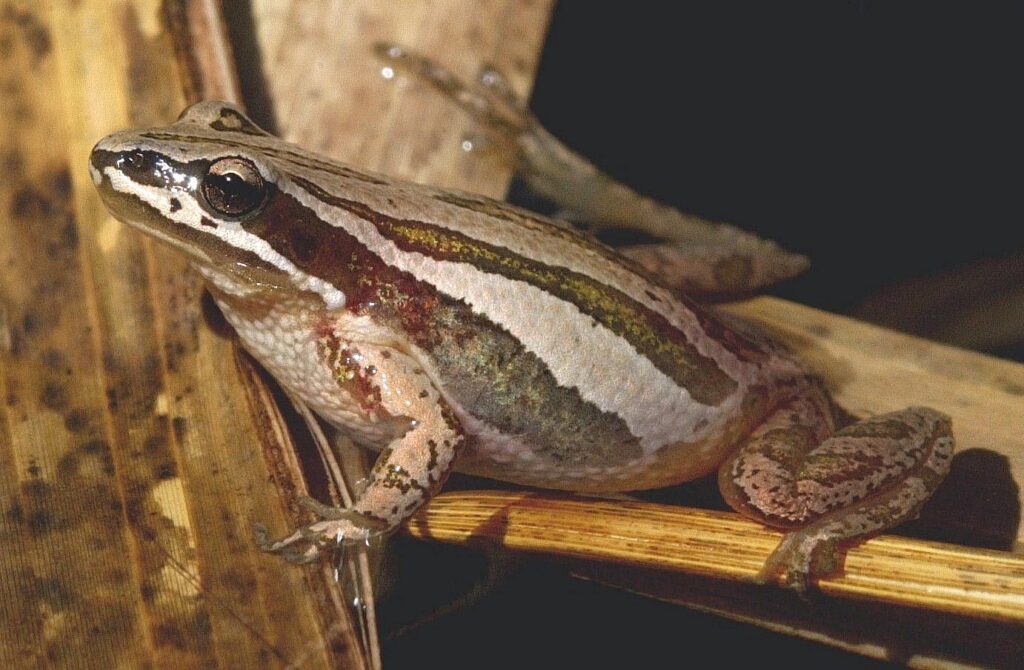
Although their communal vocalizations attain their greatest volume in the dark of night, chorus frogs are also happy to sing during the daylight hours. As is the case with all frogs or toads, the calling is solely the domain of males hoping to attract prospective mates. Last week, I was able to spend two consecutive mornings studying – or at least attempting to study – the chorus frog’s amazing spring ritual.
On both mornings, the displays began shortly after sunrise when a couple of males conducted some half-hearted calling – sort of like a high school band tuning up for an evening concert. By mid-morning, the water temp had soared into the upper 30s, causing the pond to come alive as more and more males joined the chorus. By now, all previous lack of enthusiasm had vanished. By contrast, the mutual calling had become downright exuberant. The sound would be best described as loud, continuous, and overlapping – a condition known to professional herpetologists as ‘full chorus’. Although the deafening chorus was certainly exciting, there was also a problem. I was hearing, but not seeing, the frogs I had come to observe.
If you’ve ever tried to spot a singing chorus frog, then you already know how difficult it can be. Chorus frogs are ventriloquistic. They can throw, or misdirect, their voices to make it sound as if they’re somewhere they’re not — or at least it seems that way to me. Despite the fact that I was sitting within feet of several singing males, I was unable to spot even one of the tiny crooners. Although I was staring at the precise, pinpoint spot where my ears told me a calling frog was sitting, all I could see was floating duckweed and last year’s dead bulrush. At long last, I finally did spot a frog — but only because it moved to adjust its position.

Keeping a close watch on my newly located subject, I couldn’t help but marvel at how such an ear-piercing sound could come from such a tiny creature. I eventually spotted four additional males, all singing their little hearts out in high hopes of attracting a female. No females appeared until late in the morning on the second day. While recording a male that was singing a few feet away, the head of large female suddenly popped through the duckweed, just a few inches to the right of the loudest crooner. The appearance of the female escalated the frequency of calling to where I thought the male’s throat pouch might suddenly explode like an over inflated balloon. By the end of the second morning, I had logged in around twelve hours at the frog pond. And although I’ve enjoyed listening to chorus frogs for decades, this was the first time that I’d been able to observe the species’ annual ritual in such detail.
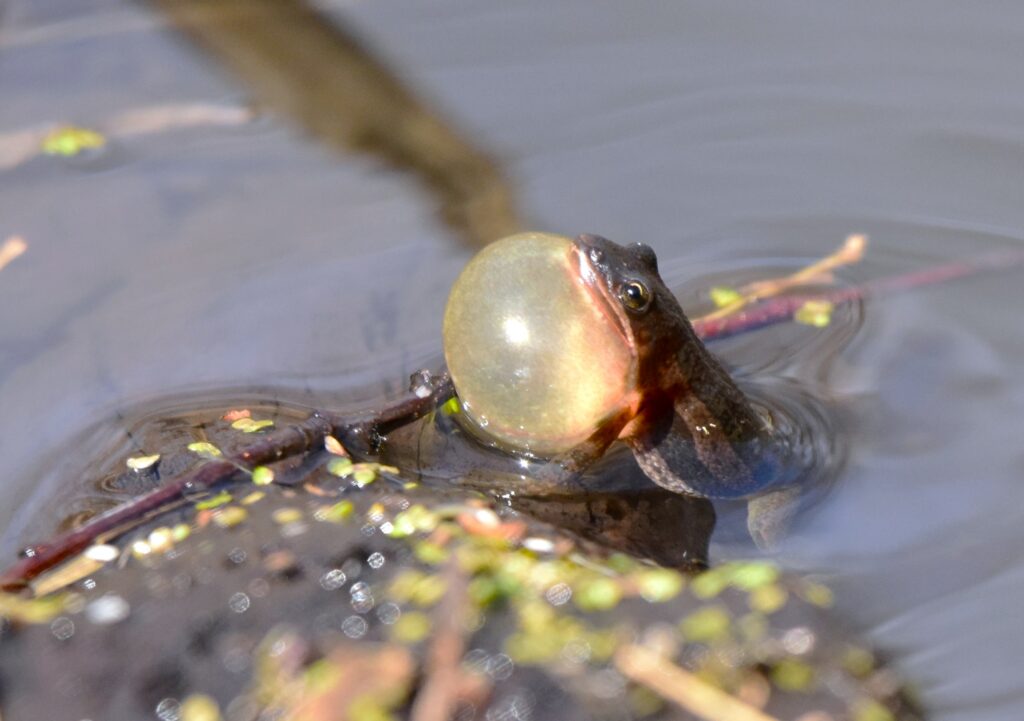
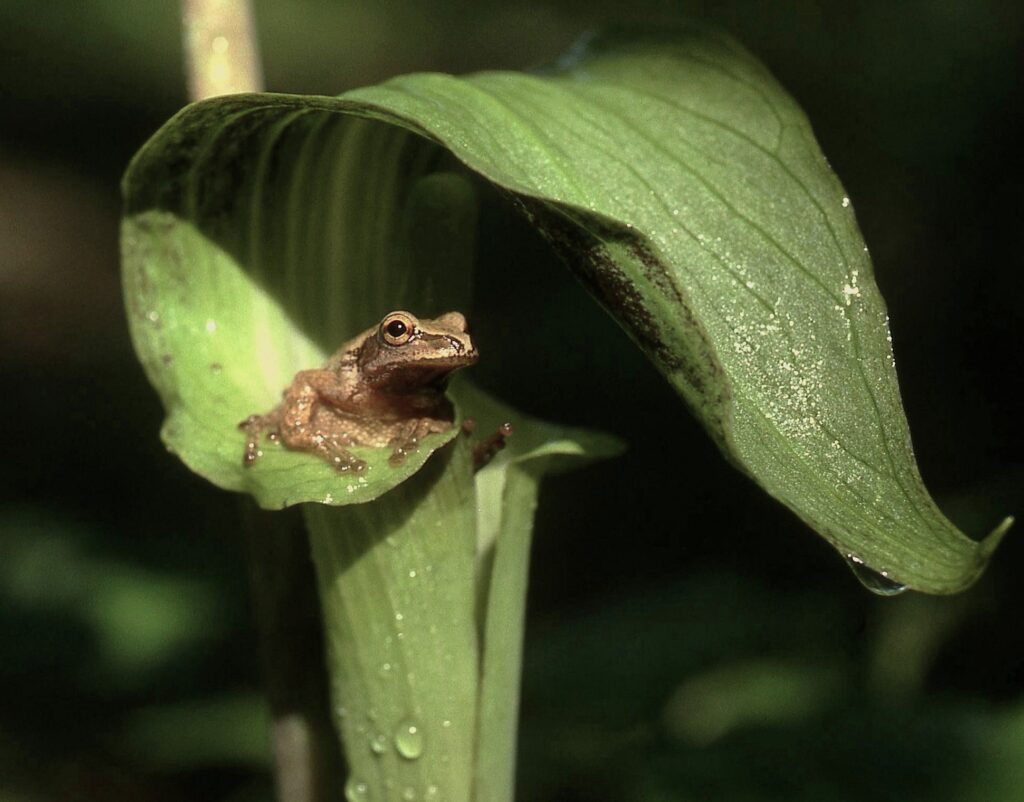
The spring peeper is another of Iowa’s early season emergers. An uncommon to rare inhabitant of northeastern Iowa woodlands, the peeper is almost as small as the chorus frog. Their nocturnal spring call is single high-pitched, bell-like note that is repeated over and over. In Clayton County’s limestone bluff country, there are three active colonies of peepers that I especially love to visit. When any one of these ponds go ‘full chorus’, it is a sound like you’ve never heard; and is one you’ll never forget. Spend more than ten or fifteen minutes at one of these sites and your ear drums will become so over stimulated, that the chirping calls will get locked into your head. Long after you leave the site, the ringing of a hundred tiny bells will continue to play over and over and over in your mind. Not kidding. It is one of the strangest phenomena in the Iowa outdoors.

 Craig Parker
 Ann Wolf
 Thomas Rinehart
 Susan Judkins Josten
 Rudi Roeslein
 Elyssa McFarland
 Mark Langgin
 Adam Janke
 Joe Henry
 Sue Wilkinson
 Tom Cope
 Kristin Ashenbrenner
 Joe Wilkinson
 Dr. Tammy Mildenstein
 Sean McMahon