
Photography courtesy of Lowell Washburn, all rights reserved.
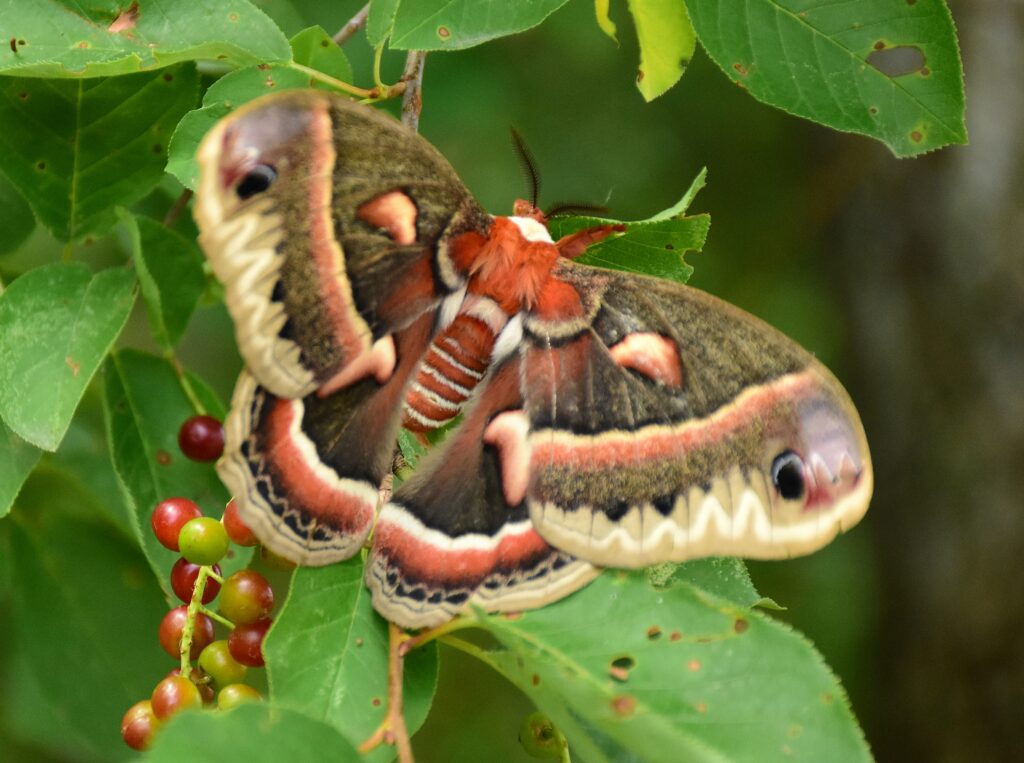
Keep your eyeballs peeled for the next several days and you might see something special. Giant silkworm cecropia moths are currently emerging across Iowa. Adorned in colorful pastels and equipped with seven inch wingspans, cecropia moths are one insect that would be hard to miss. The largest member of the silkworms, cecropias are huge. Of all the eleven thousand plus species of North American moths, none have wider wings, attain heavier weights, or are more beautiful than the mighty cecropia.
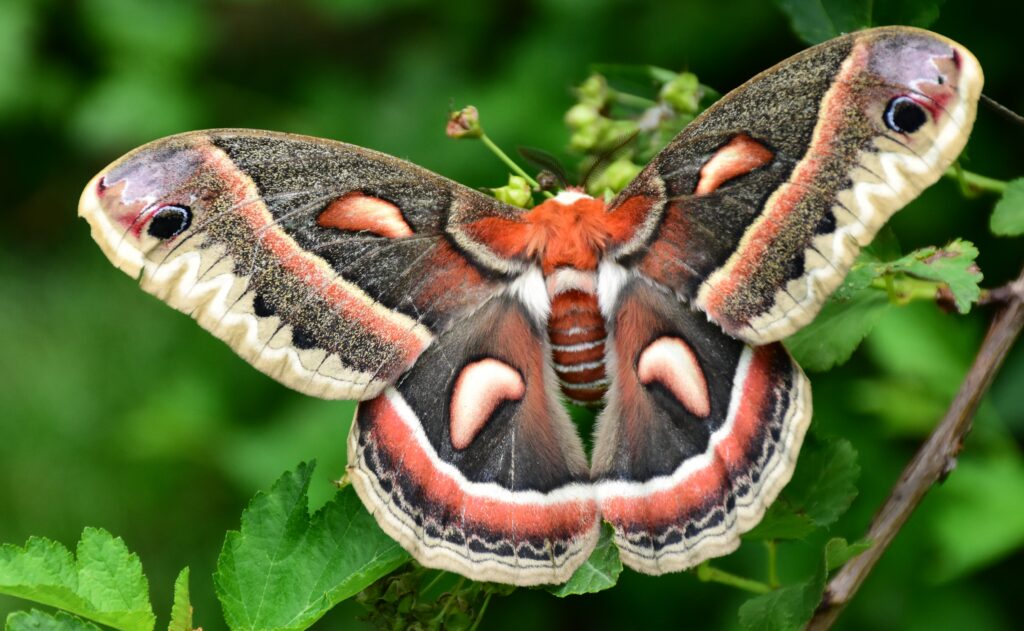
My first encounter with the species came when I was in fourth or fifth grade and my dad collected a gravid female from one of our window screens. Placing the huge insect into an empty pickle jar, I spent the rest of the night marveling at the moth’s beauty. The next morning, I awoke to discover that the moth had attached dozens of eggs to the side of the glass jar as well as on the leafy branch that that I had installed as a perch. After we released the female; I kept a close vigil on the jar to see what would happen to the eggs. A few days later, nearly all of the eggs hatched into tiny dark caterpillars. I placed the open container on the edge of our lawn, and the caterpillars lost no time in disappearing into nearby habitats. Now that I think about it, I guess those cecropia eggs were one of my first science projects.
Like all silkworms, cecropias have an interestingly complex life cycle. After emerging from their eggs as tiny dark caterpillars, cecropia larvae go through five distinct stages of development, becoming bigger and better with each new change. By late summer, the caterpillar will have grown to an amazing 4 ½ inches in length. Its base color is now mint green, and its body is studded with a colorful array of orange, blue, and yellow tubricules.
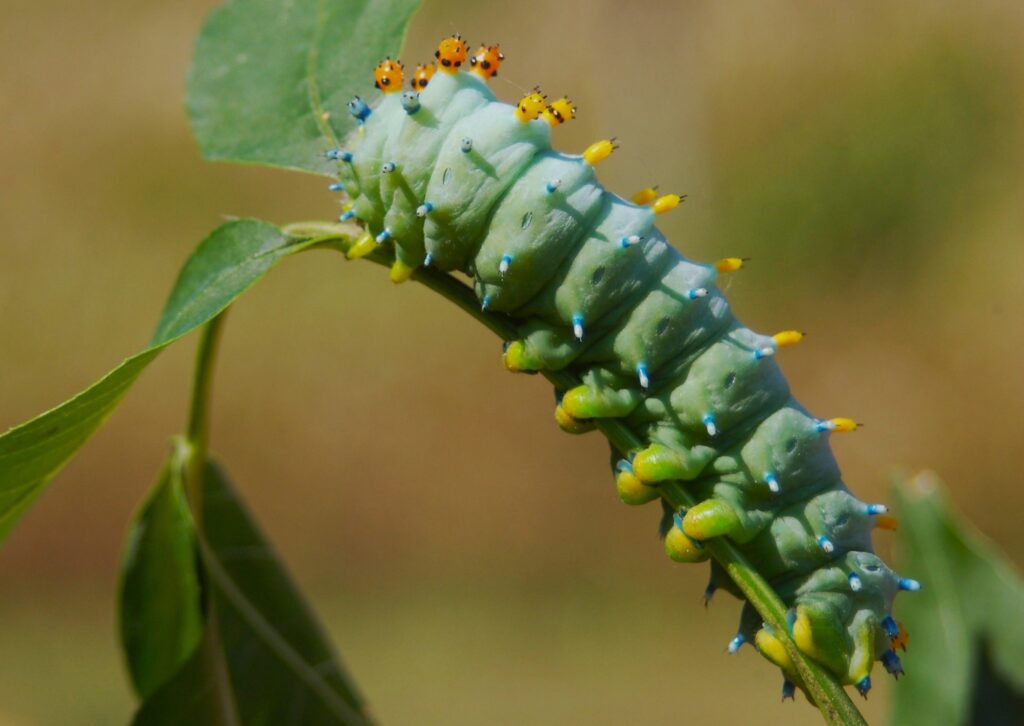
In late August or early September, the caterpillar selects its wintering site – typically a sturdy, horizontal branch. Once the site is selected, the caterpillar begins to manufacture the silk needed to build its own cocoon. The finished product is a double layered, work of art containing a soft, insulated sleeping bag on the inside, covered by a hard, camouflaged, waterproofed exterior. Once the cocoon is complete, the caterpillar morphs into a hard shelled pupae where – completely oblivious to rain, wind, sleet, or blizzard – it will lie dormant for the next ten months. When the continuing metamorphosis is complete, the colorful adults we all admire will begin to emerge in late June and July.
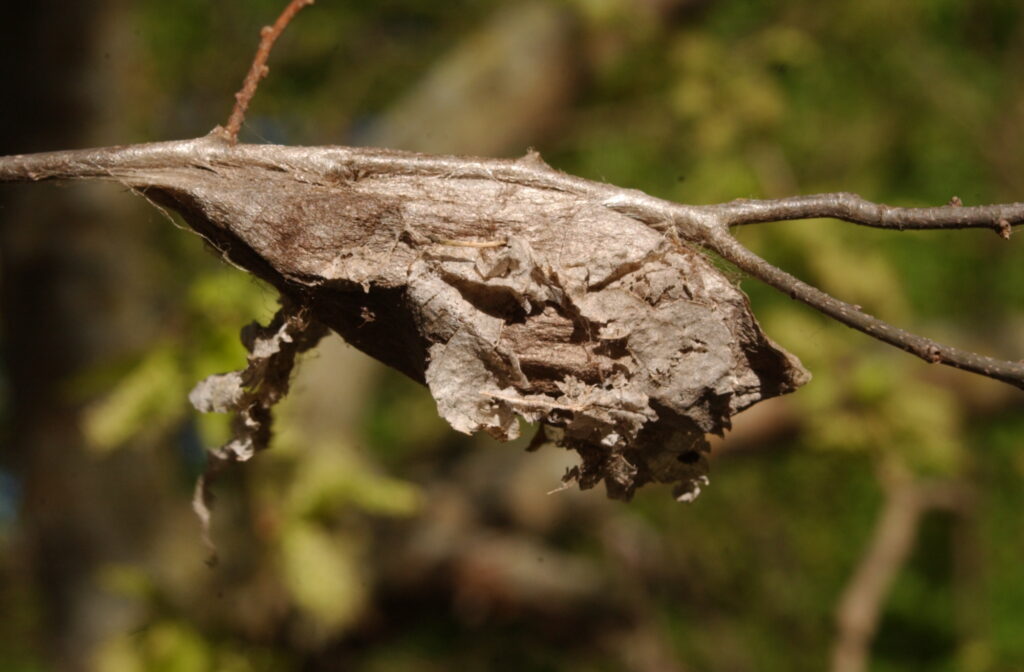
Like all silkworms, adult cecropias do not feed — ever. They are completely devoid of mouth parts and have no digestive systems. The sole purpose of their existence is to produce the next generation of moths. But time is short. An adult’s lifespan is usually less than 14 days.
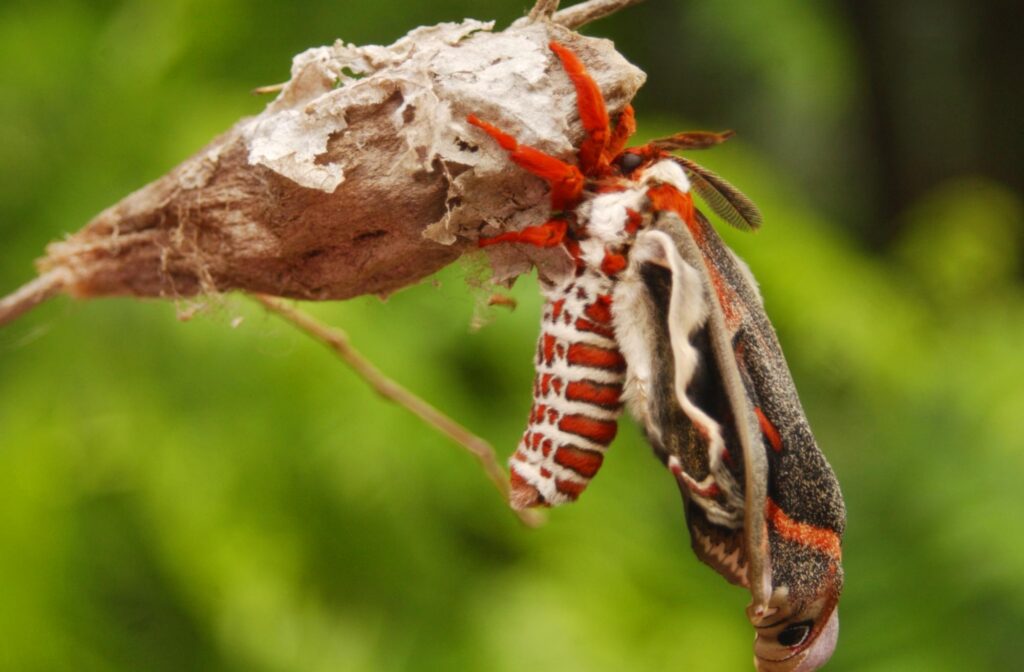
Cecropia moths are never what could be described as plentiful. Despite the fact that we are located in the heart of the species’ range, most Iowans will never see so much as a single specimen in their lifetimes. Considering this, you would think that the chances of a cecropia finding a prospective mate would pose an insurmountable challenge. But things are not always what they seem. Entomologists studying tagged cecorpias have made some amazing discoveries. Here’s a sample of what they’ve found.
After emerging from their cocoons, male cecropias began wandering the landscape in a random coarse that may cover several miles. By contrast, females spend little time on the wing. Instead, they pretty much stay put where they may be seen clinging to some unusual objects such window screens, park benches, deck furniture, etc. Reluctant to move, the females are tame and docile. But although sedentary, the females are busy broadcasting a continual stream of airborne pheromones which wandering males can detect for distances of a mile or more. Utilizing their feathery antenna to collect the scent, males follow the invisible trail directly to the female.
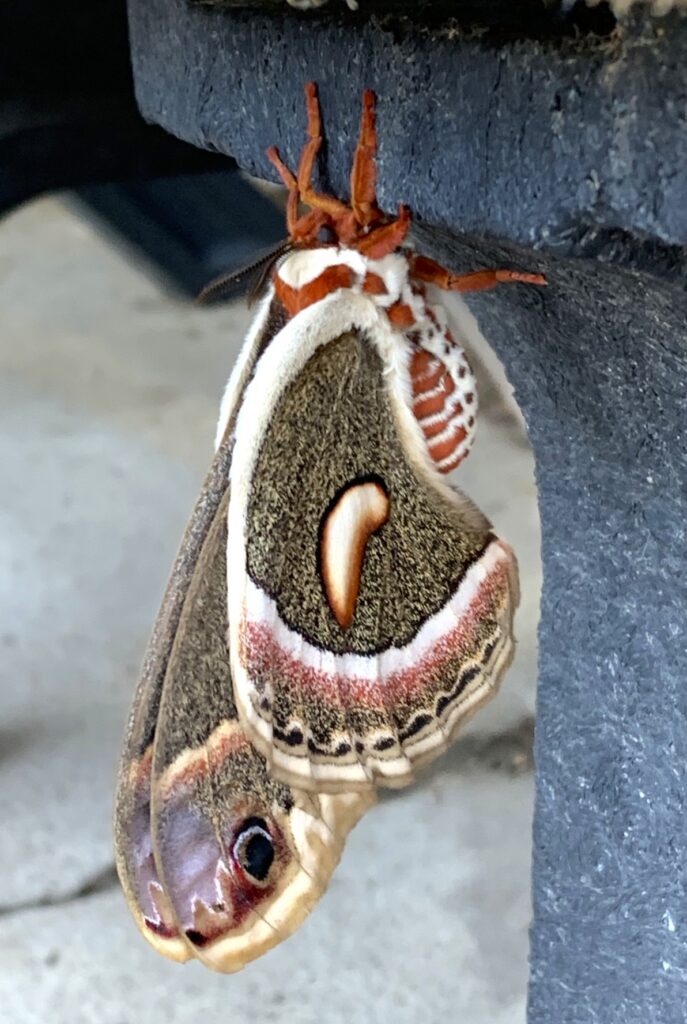
During the past week, an unusually high number of cecropia moth sightings have been reported across northern Iowa. For most folks, the sightings represent a first time encounter. I’ve had three people quiz me for ‘moth identification’ which, for me, is an unheard number of inquiries. So what’s causing this year’s spike in reported sightings? I asked the experts.
“It will be hard to pinpoint the cause behind this phenomena,” says Zach Schumm, Insect Diagnostician and Director of Iowa State University’s Plant and Insect Diagnostic Clinic.
“Every year it seems that we get reports of a specific insect being seen in higher numbers than usual. I think it’s certainly possible that [local] conditions may have resulted in a “better year” for cecropia moths,” said Schumm. “Unfortunately, there is rarely a way to determine if population surges are really happening or if they are a result of coincidental random sightings.”
“But this is very cool,” Schumm added. “I am a huge fan of silkworm moths. They are one of the reasons that I got into entomology.”

 Craig Parker
 Ann Wolf
 Thomas Rinehart
 Susan Judkins Josten
 Rudi Roeslein
 Elyssa McFarland
 Mark Langgin
 Adam Janke
 Joe Henry
 Sue Wilkinson
 Tom Cope
 Kristin Ashenbrenner
 Joe Wilkinson
 Dr. Tammy Mildenstein
 Sean McMahon