
Photography courtesy of Lowell Washburn, all rights reserved.
This year’s spring turkey seasons ended on May 17. Running for more than a month, Iowa’s spring seasons offer hunters plenty of options for bagging their gobbler while, at the same time, provides opportunities for a whole lot of high quality, outdoor recreation. But regardless of the liberal venue, there never seems to be enough days in the season. But for those who just haven’t had enough of the turkey woods, there are still some inventive ways to match wits with the legendary Timber Ghost. My favorite over-the-counter cure for the post season blues is to to grab a camera and head back to the timber. The good news is that Iowa’s ‘Wildlife Photography Season’ is never closed. Once your subject is in place, there is never a limit on many clicks you can fire off.
The days are getting long. Getting into position on roosted turkeys these days means being in the woods by 4:30 AM, at the very latest. I know that sounds brutal. But the sound of the morning’s first rattling gobble makes getting out of bed in the pitch dark well worth the effort. Although it might lack the intensity heard in early spring, there is still plenty of morning gobbling for those willing to seek it. Today’s adventure provided a classic example of a post season outing.
The morning began with two widely separated toms sounding off in the half light of the impending sunrise. Each turkey seemed to inspire the other until both birds were gobbling back and forth as quickly as one could answer the other. The gobblefest continued until one bird suddenly shut its mouth. A minute later, the sound of heavy wings told me the turkey had hit the ground. The understory vegetation has become incredibly dense with one patch of brush merging into the next. Although I could barely see past the edges of the tiny clearing I was currently babysitting, the tom’s sudden silence told me his gobbling had probably attracted a hen.
Attempting to stir things up again, I scratched out a few soft yelps on the wooden box call. Silence. Switching to the wing bone, I cranked out a series of louder, higher pitched yelps. More silence. The continuing quiet seemed to confirm my suspicions that the gobbler was with a hen.
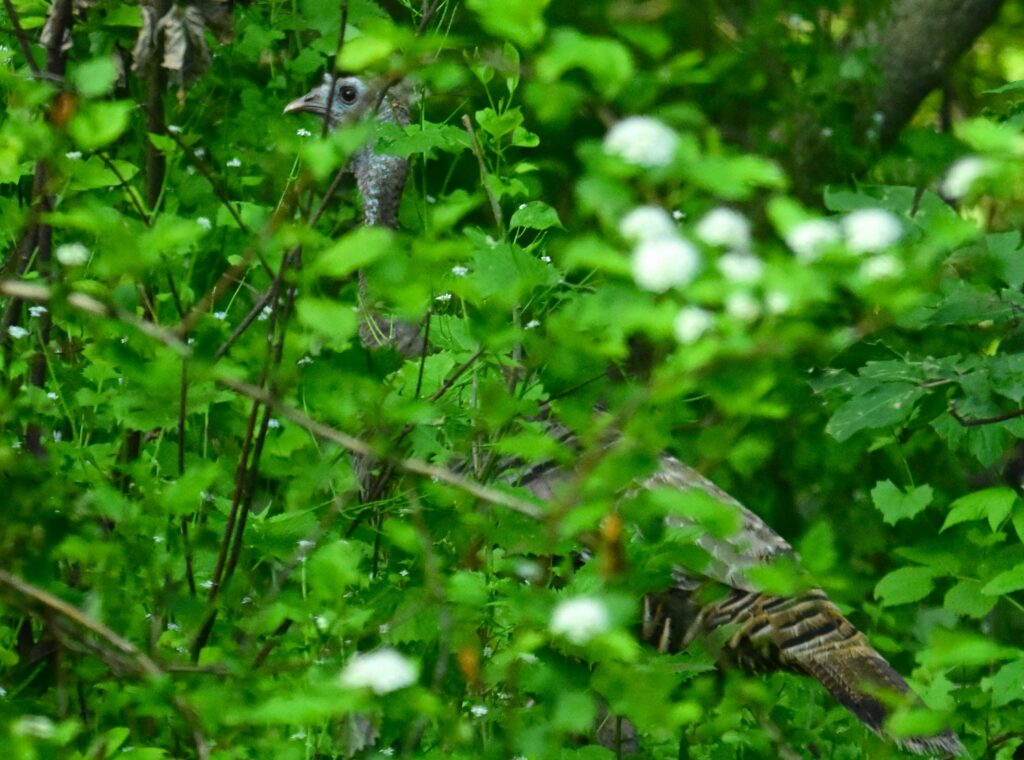
Although the second tom was still sounding off in the distance, I decided to stay put. The decision paid off. Ten minutes later, I caught a quick glimpse of what I thought was a turkey skirting the edge of the clearing. I could only see patches of the bird through the thick cover, but it moved in a way that convinced me it was a hen. I greeted her with a series soft yelps. Rejecting the invitation to socialize, the turkey never broke stride before disappearing completely a few seconds later. OK – there was the hen. Now where is the gobbler?
I kept calling. There were no answering gobbles but my spirits rose when, just four or five minutes later, I detected the approach of another big, black bird. “Oh Boy. Here he comes,” I thought to myself.
The bird vanished behind the gooseberries again, but then suddenly reappeared at the edge of the clearing. Another hen. After pecking around in the opening for a bit, the hen continued on her way. Nothing more happened for several minutes. Were there more unseen hens, I wondered? Had the gobbler left the area? If only I could get him to fire off just one single gobble to let me know he was still nearby.
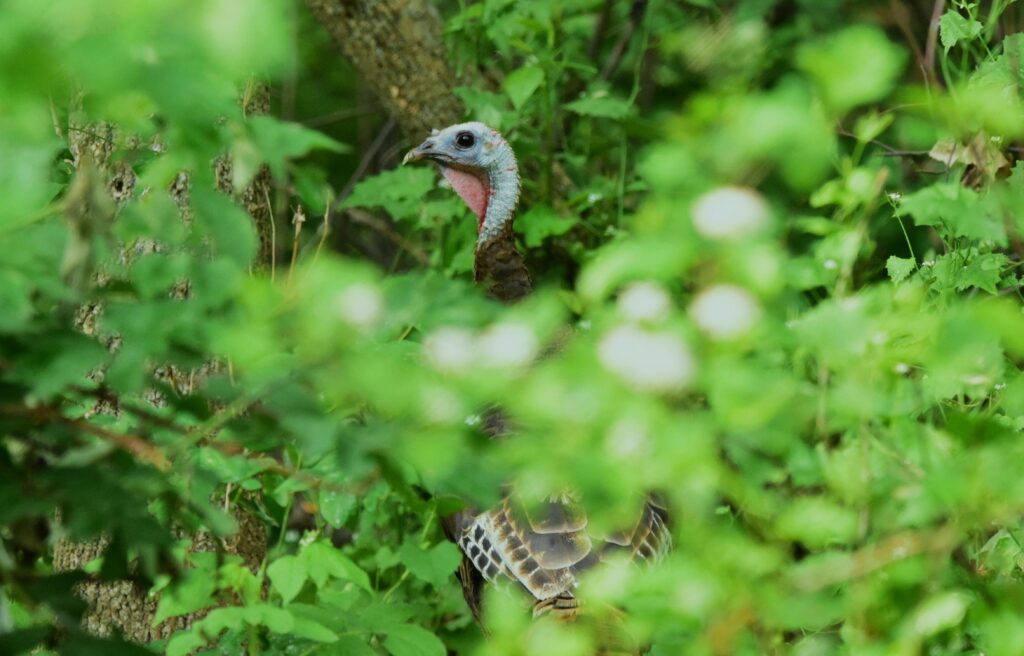
I never did get that gobble. But what I did receive was a fleeting glimpse of another dark form. This bird, however, was decidedly different from the others – bigger, blacker, and making its approach in a more cautious, much more deliberate manner. This had to be him. The gobbler I had been waiting for.
It was indeed the gobbler I had been seeking. But now that he had finally arrived, the scenario did not go as envisioned. Instead of marching directly into the clearing to pose for his stately portrait – the tom remained behind a screen of dense vegetation – the thickest of the thickest the timber had to offer. All I could catch were occasional, half second peeks as patches of jet black plumage moved through the foliage. By now, the strutting turkey was close enough that I could clearly hear his distended wings raking the forest floor. I could also hear the bird’s distinctive ‘spit & drum’ display as the tom pushed air from his lungs into the adjacent air sacs.
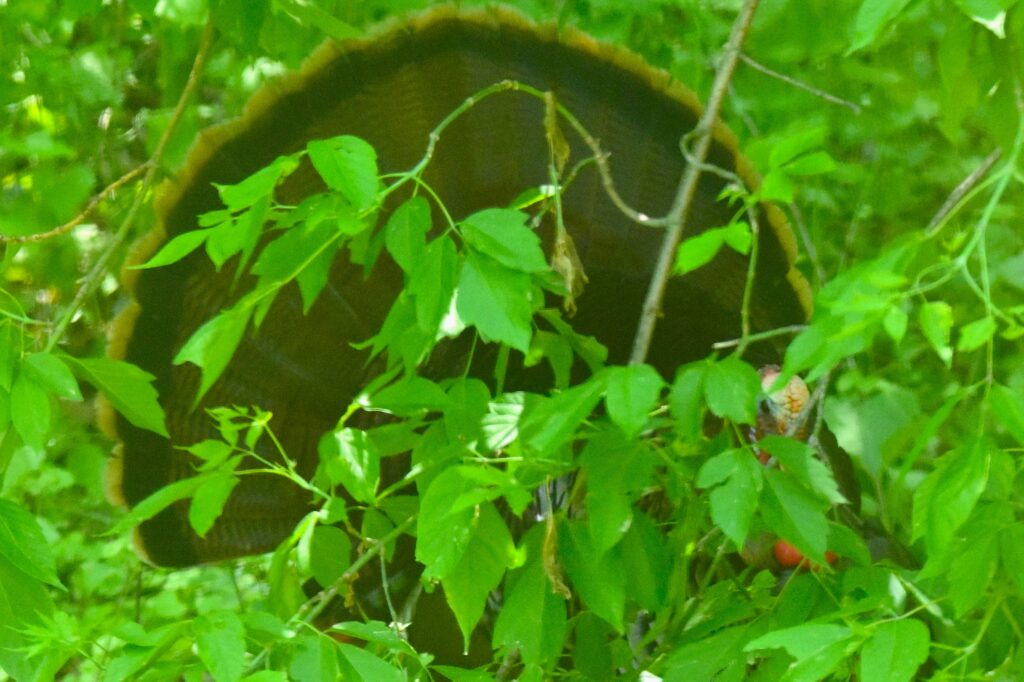
The standoff continued. Another ten minutes passed as the gobbler strutted back and forth behind the concealing green curtain. Although I had yet to fully see the wary tom, it did seem as if he was continuing to inch ever closer. There was still hope for obtaining the photos that were today’s excuse for invading the dimly lit solitude of his forested domain.
The minutes ticked by. Finally, at long last, I could see the top of the gobbler’s spread fan. A minute or two more and the strutting Long Beard began to slowly emerge from the opposite edge of the clearing. His approach was so cautious, so painstakingly slow, that it almost felt as if – one by one — each individual feather was being brushed into the scene of some magnificent woodland painting.
The gobbler’s head and neck were aflame with a vivid combination of red, white, and blue. Even in subdued lighting, the tom was as visually stunning as he was massive. With tail fanned, beard swinging, and wings dragging, the old warrior presented the absolute portrayal of natural perfection.
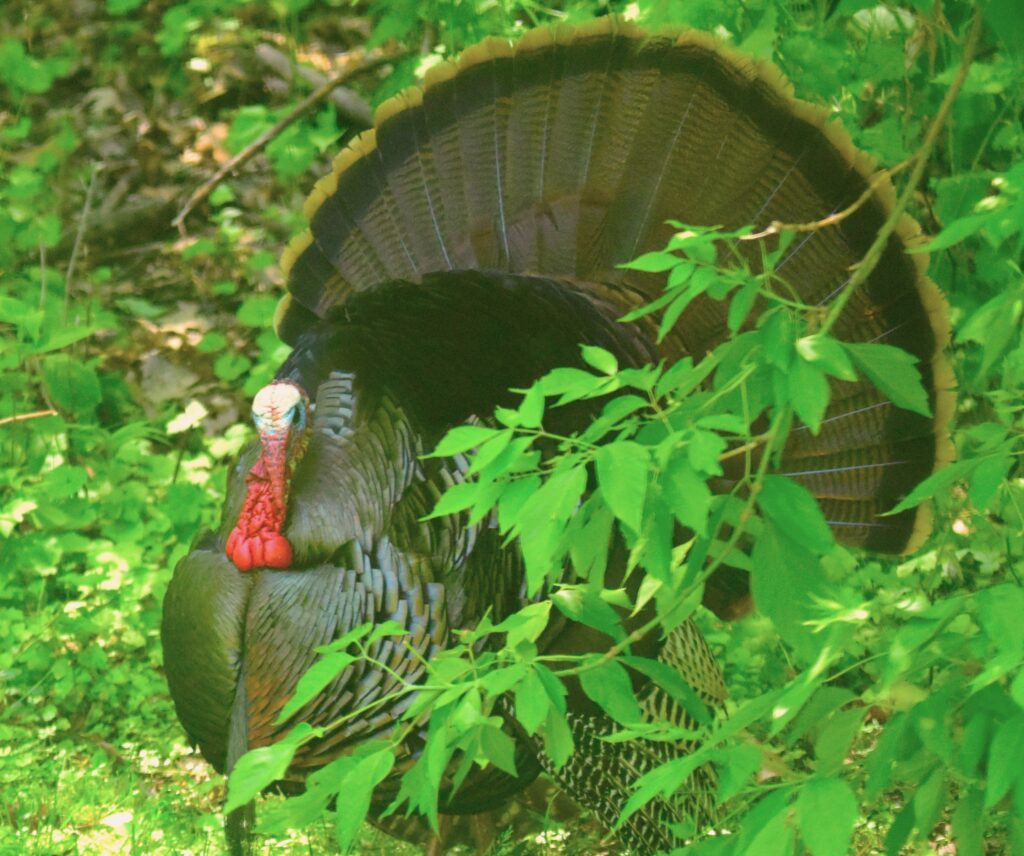
With the gobbler finally in position, the long wait was over. Taking a deep breath, I slowly pressed the shutter. As always, the early morning adventure had been well worth the effort.
 Craig Parker
 Ann Wolf
 Thomas Rinehart
 Susan Judkins Josten
 Rudi Roeslein
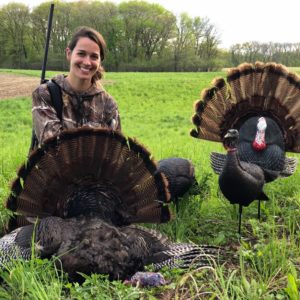 Elyssa McFarland
 Mark Langgin
 Adam Janke
 Joe Henry
 Sue Wilkinson
 Tom Cope
 Kristin Ashenbrenner
 Joe Wilkinson
 Dr. Tammy Mildenstein
 Sean McMahon