
Photography courtesy of Lowell Washburn, all rights reserved.
My friends Bruce and Diane Rich own a beautiful woodland in Northern Iowa. Although I occasionally hunt squirrels, deer, or turkeys there, I mostly come to the woods to shoot photos. In addition to timber, the tract also harbors a small pond where I often set up to encounter the widest variety of wildlife – everything from deer and raccoons to ducks and songbirds.
Several pairs of nesting wood ducks use the pond as spring headquarters and I always try to spend a several mornings observing these unique birds. In addition to the woodies, a pair of mallards had also set up a territory on the pond this spring. Shortly after sunrise each morning, the pair would leave the pond with the drake following the hen as she searched nearby habitats for a nesting site. The pair would typically be gone for an hour or two before returning to the pond to feed, preen, and nap for the remainder of the day.
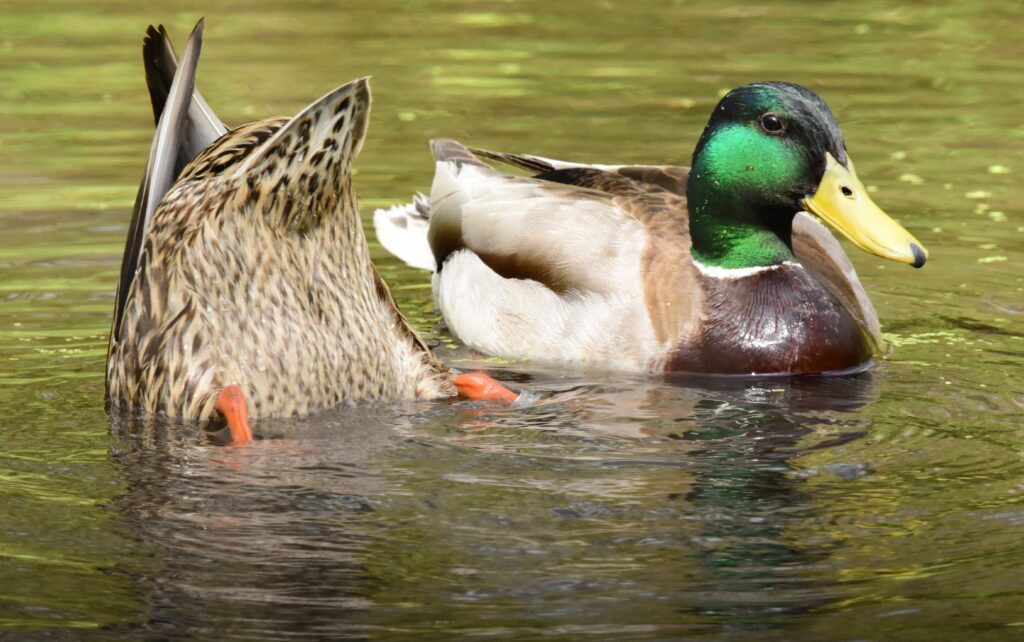
In typical mallard fashion, the pair would feed by ‘tipping up’ while scouring the pond’s basement for preferred delicacies such as aquatic plant seeds, snails, baby crayfish, etc. It was while the mallards were engaged in this activity that I noticed that the hen was wearing jewelry in the form of a U.S. Fish & Wildlife Service bird band. The sighting of a banded bird never fails to the spark the imagination. Where did the bird come from? How old is it? Or where is it going?
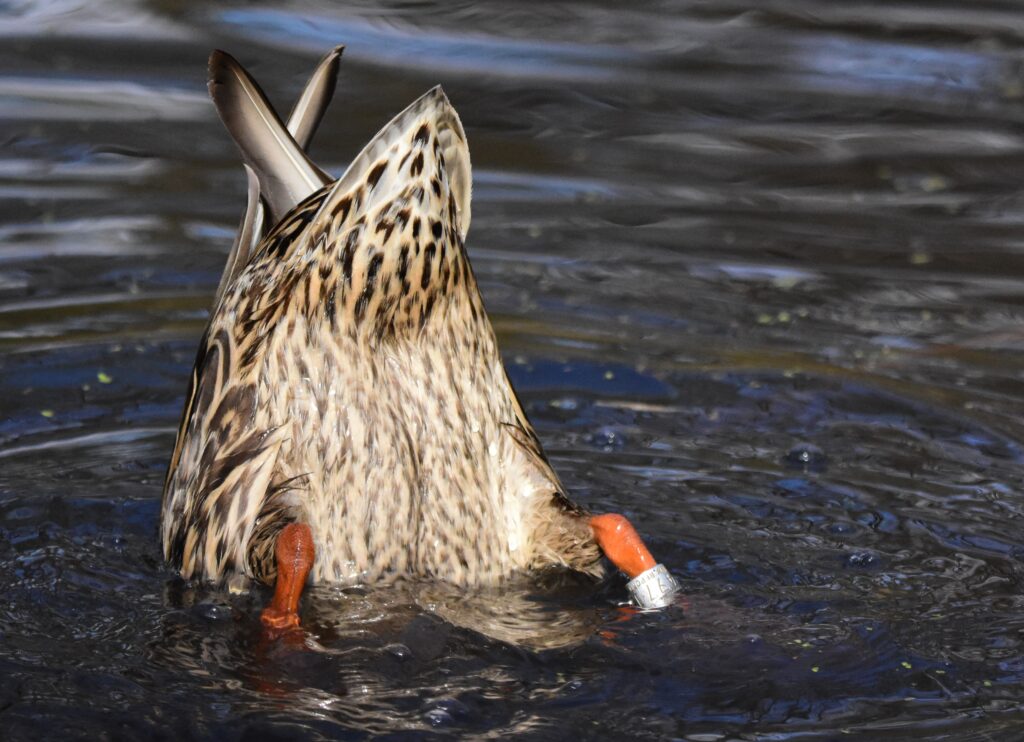
As the season progressed, the pair’s morning forays continued, but the drake would often return to the pond several minutes in advance of the female which made me believe that she had chosen a nest site and was now in the process of laying her clutch of eggs. As the days passed, the drake began spending most of his time alone. But each day the incubating hen would reappear and sail into the pond at about mid-morning. After spending up to an hour feeding and preening, the hen would return to her nest.
Mallard drakes do not help in the rearing of young. And it came as no surprise when, about a week later, the male disappeared – presumably to join a bachelor group for the summer molt. Although my visits became less frequent during the last half of May, I continued to observe, and often photograph, the nesting hen during each trip.
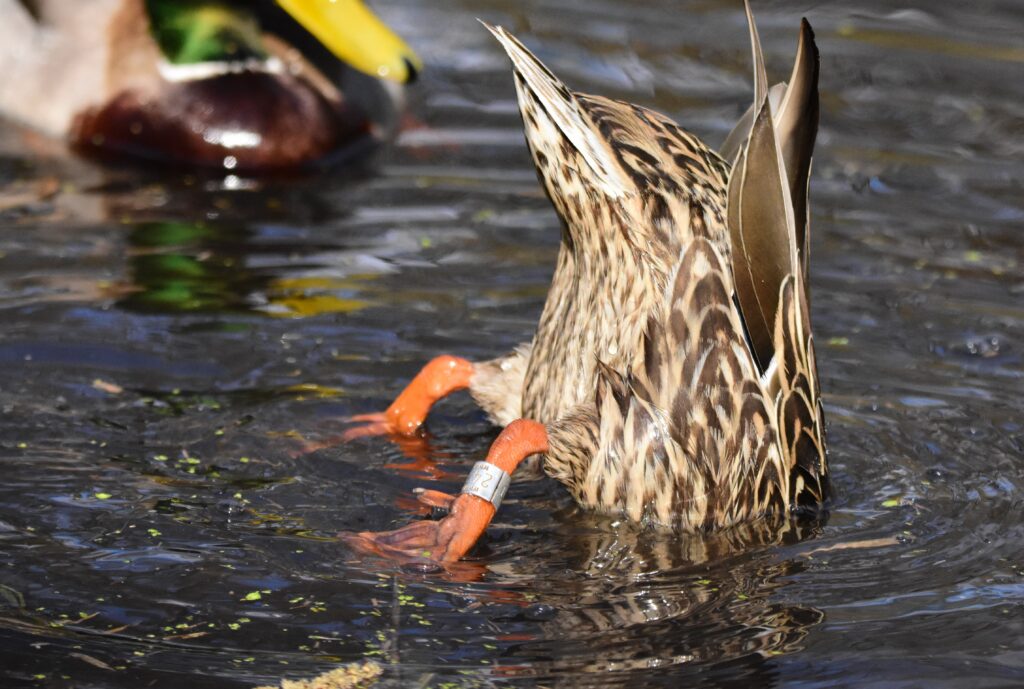
A few days ago, I was reviewing some spring songbird photos which also included some shots of the mallard pair at the pond. The hen’s band was quite visible on some of those shots — so much so that on some frames I could clearly read one or two of the numbers. After going back and forth through the series I was eventually able to assemble the entire nine digit sequence. It isn’t very often that you can record a waterfowl band without actually laying hands on the bird, but in this case it worked out. Electronically reporting the band to the National Bird Banding Lab in Laurel, Maryland, I discovered that the hen – already an adult — had been banded August 31, 2025 near Newburg, North Dakota.
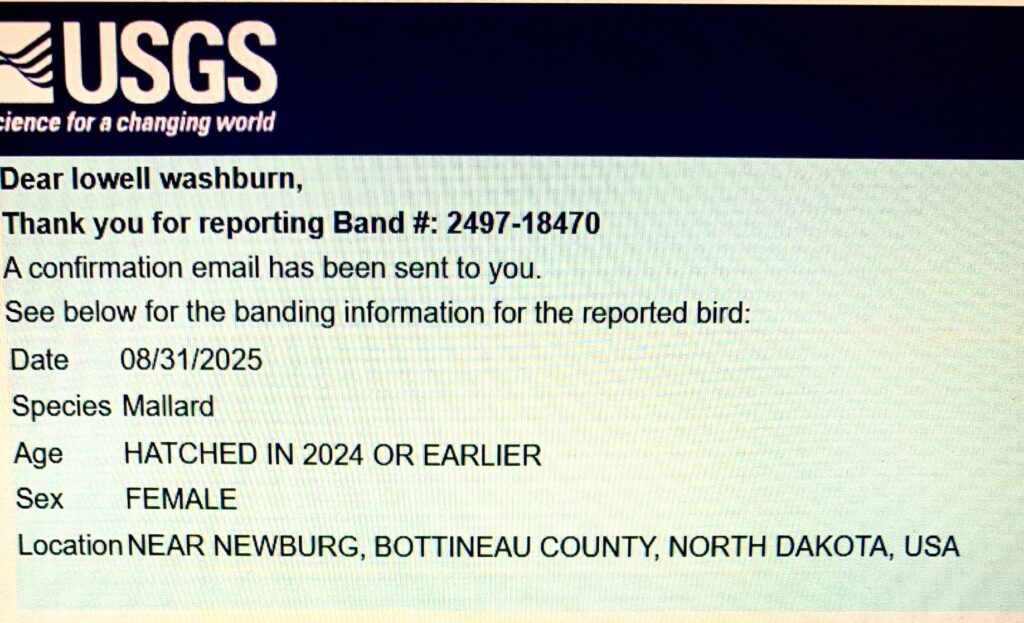
But although the report answered the question of where the bird was banded, it raised another. As adults, mallard hens have a very strong propensity to return to their natal areas to nest. So why would an adult hen originating in North Dakota be nesting in Iowa? It may have been because the hen wasn’t from North Dakota at all, but had actually been hatched right here in northern Iowa. Since she was banded at the end of August, I think it might be a good guess that she actually nested in Iowa during 2025. Waterfowl populations are extremely mobile. Once the nesting season concluded, she may have just wandered 650 miles north to North Dakota where she was captured and marked. Will never know for sure, of course, but it’s always fun to speculate. Banded birds never fail to spark the imagination.

 Craig Parker
 Ann Wolf
 Thomas Rinehart
 Susan Judkins Josten
 Rudi Roeslein
 Elyssa McFarland
 Mark Langgin
 Adam Janke
 Joe Henry
 Sue Wilkinson
 Tom Cope
 Kristin Ashenbrenner
 Joe Wilkinson
 Dr. Tammy Mildenstein
 Sean McMahon