
Photography courtesy of Lowell Washburn, all rights reserved.
Elvis has left the building. For all practical purposes, this year’s spring snow goose season is over. Not because of any calendar date, but rather because one of the planet’s most highly migratory bird species has left the state — faithfully following the invisible pathways that lead to the arctic nesting grounds of their ancestors.
This year’s spring migration has been a dramatic event. Pushing hard on the edge of a retreating snow line, massive flocks of northbound adults were the first to arrive in Iowa. Depending on where you were, the Big Push lasted for three or four days. Once most of those adults had vanished to the north, a second wave of migration moved into the state. This second flight was comprised mostly of juvies, younger birds that won’t nest for at least another year or two. Although they are also on the way to summer tundras, young birds adopt a more leisurely approach to the annual migration. The arrival of juveniles marks the tail end of the spring flight. It is my favorite time to hunt the white birds.
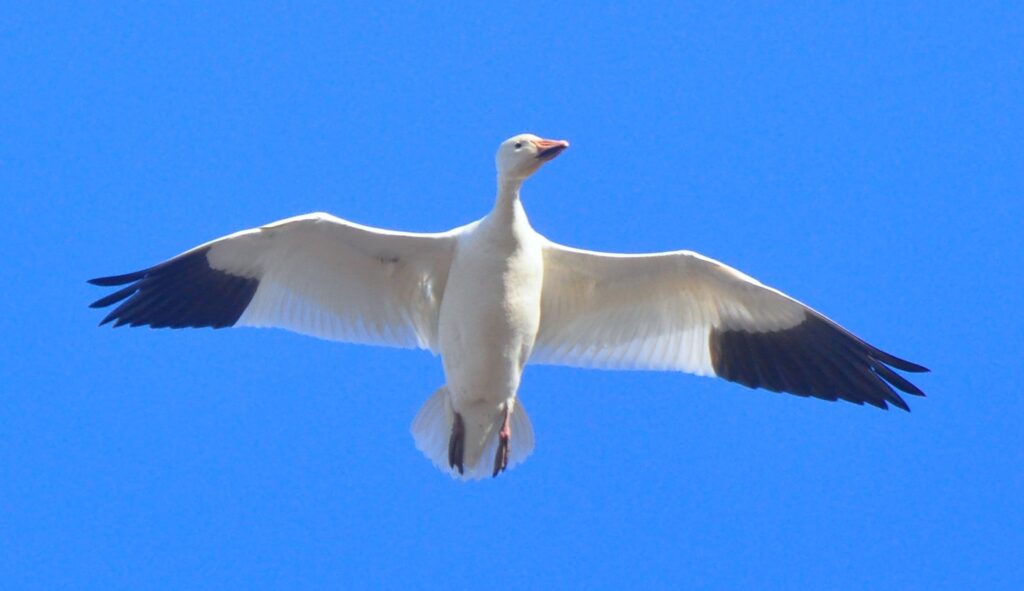
Traveling in flocks containing hundreds, or even thousands of birds, snow geese are considered to be the most difficult of all wildfowl to lure to decoys. Hunting the wary species represents an enormous undertaking involving hundreds and, at times, upwards of a thousand or more decoys. Any way you slice it, placing one of these mega-spreads requires hours of backbreaking hard work – which brings us back to those beloved juvies.
Instead of covering the skies with endless skeins of high altitude formations, immature snow geese tend to migrate in much smaller more cooperative flocks, sometimes traveling in groups numbering as low as 20 to 100 birds. Where I hunt snow geese in northern Iowa, there are no mega-spreads – at least none that I’ve heard of. Instead, spreads containing 200 to 300 or so decoys are the norm.
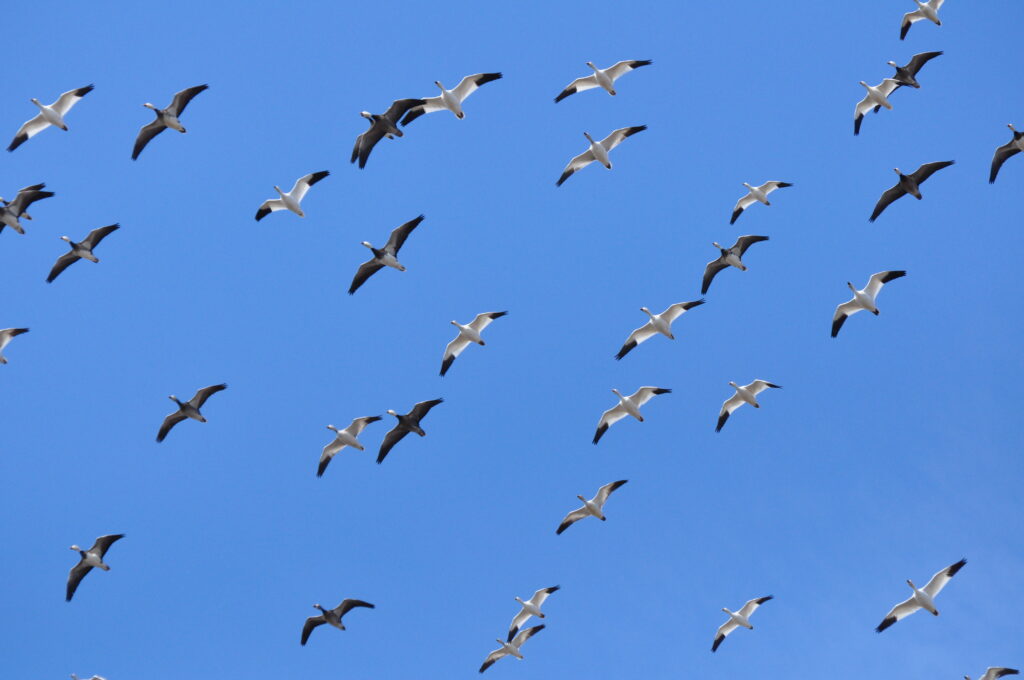
Despite their inexperience, younger birds are not without challenge. Upon spotting your decoys, most flocks will set their wings and begin losing altitude while cautiously inspecting the layout. With each noisy pass the birds become lower and closer. Your heartbeat quickens. Just one more swing and the birds will be within easy range. But just when you think you have the birds completely duped, the flock’s next pass is a bit higher. The next swing is higher yet, and you realize the game is over. As the geese become specks on the horizon, the rejection becomes even more painful when you consider that their lowest swing was at a mere 25 yards. In the final analysis, it was the hunter and not the geese that was fooled.
“I won’t let that happen again,” you think to yourself.
Migrating ducks also love to buzz snow goose spreads. And whether or not you manage to bag any geese, the spring waterfowl show is easily worth whatever effort it took to get set up. Last Tuesday, I hunted on a hilltop where brisk winds were gusting in excess of 25 mph. At daybreak, I had two flocks of white-fronted geese [not legal game] give me a serious look. It was a good start to the morning, and I always thrill to the sound of the white-front’s zebra-like, whinnying call.
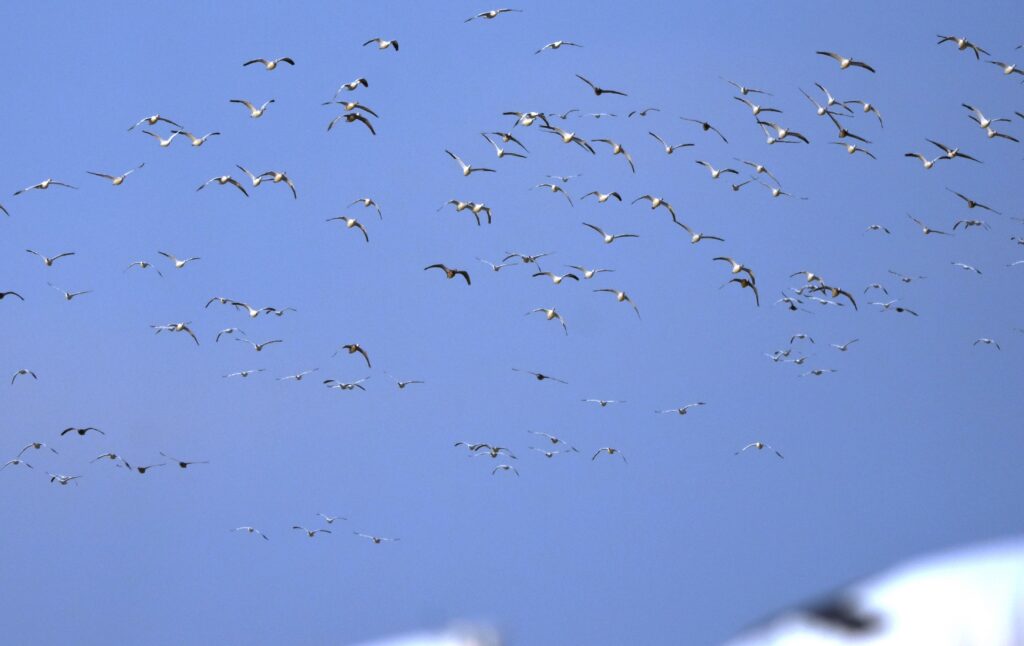
The white-fronts were followed by endless flocks of curious, low level ducks. It wasn’t until well after sunrise when the juvie snows began to arrive. The first flock contained around 50 birds which immediately locked unto my decoys. Laboring into the wind, the flock approached to a distance of around 25 – maybe 30 – yards before sharply veering off. During the next two hours, this same scenario was repeated time and again with flocks – some containing upwards of 100 geese — approaching to 30 to 40 yards before turning away. After having an amazing procession of 12 flocks check out my decoys, the flight suddenly shut off as dramatically as it had started. Although I never fired a shot, I look back on the morning as one of this year’s most exciting outings. I was using wind sock decoys and I think, that at least on this occasion, the wind was actually giving the decoys too much instead of too little motion.
Spring weather is volatile, and snow goose hunts offer a wide array of extremes. A couple of days before that windy morning hunt occurred, my son, Matt joined me in this same field. The skies were clear and a nice breeze was coming from the southwest. Placing decoys by the light of our headlamps, we had the spread mostly in place by first light. Then, instead of increasing as predicted, the rising breeze suddenly stopped. As a result, our gently waving wind sock decoys died on the vine. Instead of looking like actively feeding geese, our spread suddenly took on the appearance of 200 limp diapers hanging on a stick.
Within minutes, the first geese appeared. Coming to, and passing directly over our decoys, the geese said “forget it” and moved on. This happened again and again, with goose flocks never lowering to below the 40 yard line. Finally running out of time, we were about to pack it in when we heard the single yelp of a lone goose. The sound came from a passing Ross’ goose — a tiny mallard-sized, arctic nesting, lookalike cousin of the snow goose.
When Matt hit the call, the Ross’ cupped its wings and immediately lowered its pink-footed landing gear. Limp diapers or not, this bird was coming in. Matt collected the goose with a well placed load of steel 4s. Although our hunt was over, we both agreed that the sight of that single white goose sailing down from a deep blue sky had made getting out of bed during the wee hours to set decoys well worth the effort.
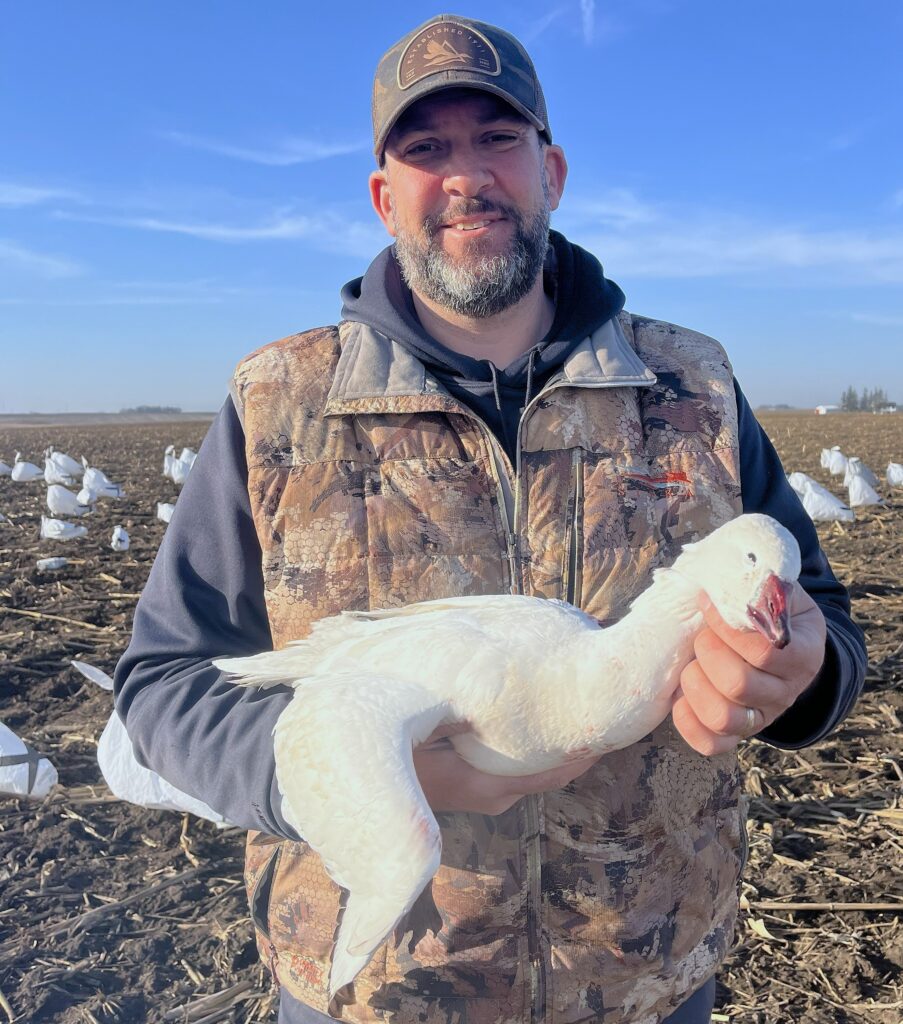
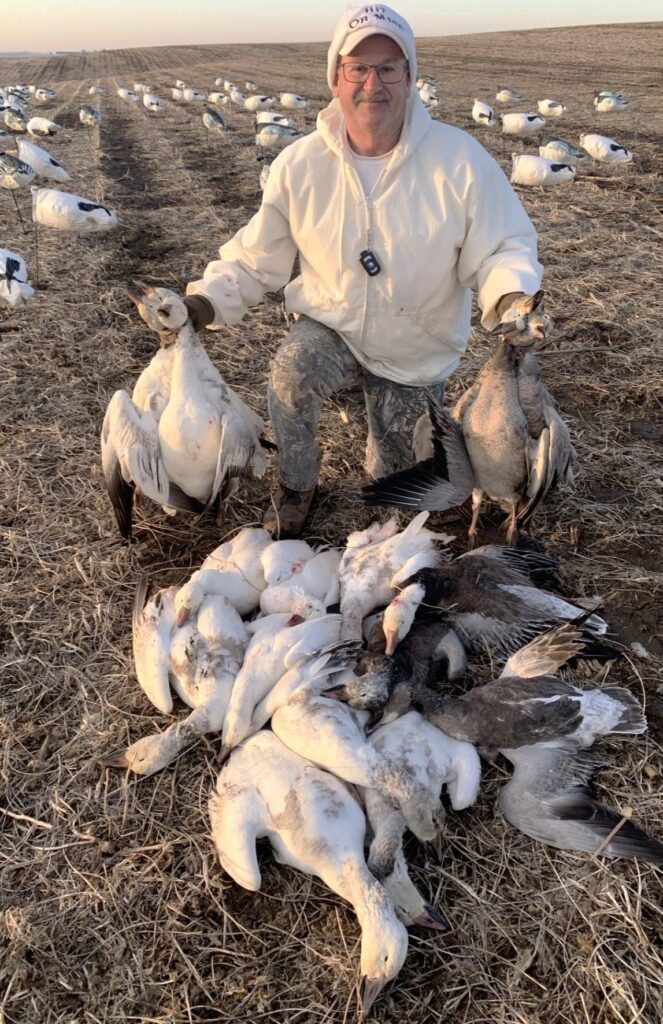
Believe it or not, there are those rare occasions when snow goose hunting goes exactly as scripted. Over the years, I’ve enjoyed several of those hunts with my friend Curt Stille. One of the most memorable occurred last spring on a day when you could hardly keep the snow geese out of the decoys. Descending to the spread like Opening Day teal – well, almost – the naive flocks were so unexpectedly abundant that I literally ran out of ammo, and Curt was down to his last couple of loads. Abandoning Stille amidst a growing pile of downed geese, I high tailed it back to my truck. Digging around under and behind the seats, I came up with a mismatched, slightly corroded handful of shells. Finishing our hunt, we both agreed that it had indeed been a day to remember.
 Craig Parker
 Ann Wolf
 Thomas Rinehart
 Susan Judkins Josten
 Rudi Roeslein
 Elyssa McFarland
 Mark Langgin
 Adam Janke
 Joe Henry
 Sue Wilkinson
 Tom Cope
 Kristin Ashenbrenner
 Joe Wilkinson
 Dr. Tammy Mildenstein
 Sean McMahon