
Photography courtesy of Lowell Washburn, all rights reserved.
One of the things I miss the most from days gone by are the jackrabbits. Ya, that’s right. I said that I miss the jackrabbits. I miss watching the spectacular, 20-foot leaps as a startled ‘jack crossed a hundred yards of cow pasture in nano seconds. I miss watching their leapfroging midnight dances when groups assembled atop the snowy backdrop of a moonlit January night. I also miss the startling moment when a crouched jackrabbit would unexpectedly explode from underfoot as I hunted my way through winter cornstalks. Yes, I really really miss Iowa jackrabbits.
I was reminded of just how much I miss this formerly abundant mammal when, late yesterday afternoon, I happened to drive past one of the spots that, back-in-the-day, was one of our favorite jackrabbit hot spots. Sadly, the area is no longer home to jackrabbits; the last one sighted here was in 1996. Equally disheartening, is the fact that most contemporary wildlife enthusiasts have never, in their entire lifetimes, seen so much as a single jackrabbit anywhere in Iowa. It’s about the same as if someone would say today that they had never seen a robin or a spotted a chickadee.
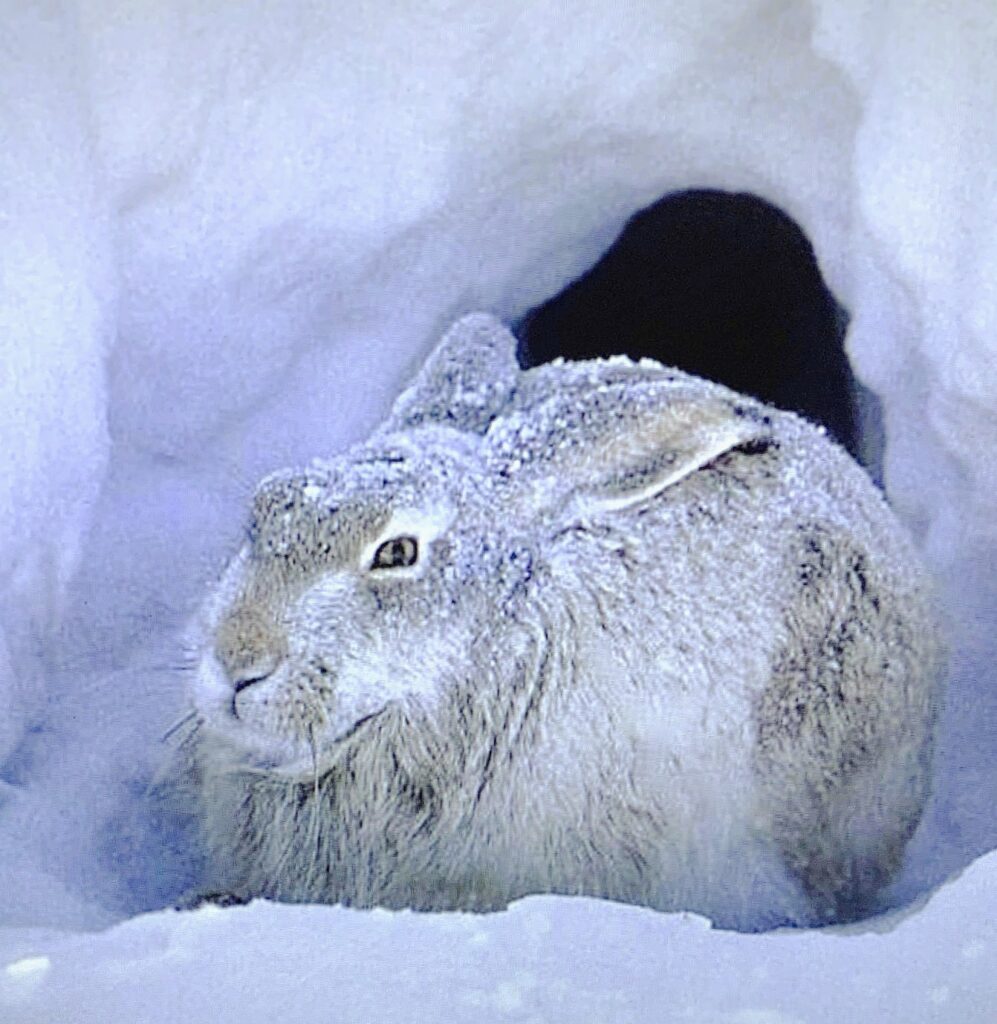
Jackrabbits are really not rabbits at all, of course, but are Iowa’s one and only species of hare: a fact which, to me, makes the disappearance of what was once such an abundant and recreationally important Iowa resource seem even more alarming. The jackrabbit’s demise is indeed a sad tale.
My introduction to jackrabbits occurred during the early 1960s. During that era, white-tailed jackrabbits were a plentiful and popular Iowa game species. Most of my early encounters came while hunting pheasants in cut cornstalks. I eventually began to pursue them in the wide open pasturelands where jackrabbits were most plentiful. During weekend forays, I was often accompanied by three or four of my high school classmates.
Back then, jackrabbits were about as close as to big game as most hunters were likely to get. Although populations abounded across most of the countryside, our most favored hunting grounds were in the vicinity of the Linden Ranch – the current location of Cerro Gordo County’s 2,000 plus acre Union Hills Wildlife Area. Located near Thornton, the ranch’s sharply rolling terrain was better suited to grazing than it was to row crops. The sprawling mix of short pasture, boggy lowland, and natural prairie potholes presented a perfect mosaic where cattle, jackrabbits, and teen-aged hunters thrived.
Finding game was not an issue. The first loping jackrabbits would often be sighted while we were still pulling on jackets or filling our pockets with ammo. Once the hunt was underway, our shots would vary from animals sitting at 75 yards or more to concealed, flattened out ‘jacks that literally jumped at out feet. Most of us carried .22 rifles or shotguns loaded with heavy charges of #2 shot. Although most of us were limited to short range shots, my friend Craig Buehler was a classic exception. Buehler was the current owner/operator of a slim lined little .22 Hornet rifle. Equipped with a quality scope, the diminutive little center fire could drive tacks out to ranges of 100 yards, making Buehler big poison on those long range shots. To have two or three hares running ahead of us at the same time was not uncommon. Although our combined take was never what it should have been, we did sometimes bag enough to make carrying the hefty 8 and 9 pound critters back to the road a two trip endeavor.
Although our hunts provided enough excitement to keep our teenage pulse rates elevated, our activities paled in comparison to the organized safaris adults were conducting. The most dramatic examples came from the so called circle hunts. Jackrabbits were considered to be a nuisance by alfalfa farmers and circle hunts were an attempted means of reducing populations. As the name implies, circle hunts consisted of parties containing multiple hunters surrounding a jackrabbit laden tract of habitat and then slowly marching in for the kill. The results of these efforts were astonishing. During a 1961 winter hunt, Conservation Officer Frank Starr reported 99 jackrabbits killed and only 15 escapees from a successful circle hunt that occurred on a single section of land near Storm Lake. During a similar hunt, Conservation Officer Jim Ripple reported 90 jacks killed from a single section near Lidderdale. Conservation Officer, James Baldwin reported that 458 jackrabbits were killed while an additional 307 escaped during a combined series of nine circle hunts conducted in Clay County during the winter of 1959-60. Although Iowa Conservation Commission [now DNR] archives contain detailed information regarding 32 Northern Iowa circle hunts, there is no report of a single human injury resulting from hunts that would give today’s hunter safety instructors a case of screaming nightmares.
Although a staggering number of jackrabbits were killed during those organized hunts, circle drives failed to reduce populations as the animals quickly replaced their losses. All told, more than 100,000 jackrabbits were annually harvested in Iowa during the 1960s and early 1970s. Many made their way to eager markets where the meat supplied protein to local mink ranches, while winter pelts were used to make felt garment liners. Thousands more were taken to local county court houses to collect lucrative 10 cent bounties. The jackrabbits my classmates and I killed were never bountied, but were instead served at family dinners.
Early [1960s] wildlife surveys revealed that breeding populations of white-tailed jackrabbits were present across most of Iowa. The highest densities occurred in north central and northwest Iowa where winter counts sometimes exceeded an amazing 100 ‘jacks per square mile, and populations of 30 or more animals per square mile were not uncommon. Today, jackrabbits are rarely – if ever – observed across their former Iowa ranges. No jackrabbits [zero] were reported during the 2008 August Roadside Game Survey, and only one was tallied during the 2009 August Survey. The hunting season on jackrabbits was closed in 2011.
The equivalent of an endangered species, Iowa jackrabbits are no longer considered to be a nuisance in Iowa. A dramatic shift in modern-day agricultural practices has accomplished what organized circle drives never could.

 Susan Judkins Josten
 Rudi Roeslein
 Elyssa McFarland
 Mark Langgin
 Adam Janke
 Joe Henry
 Sue Wilkinson
 Tom Cope
 Kristin Ashenbrenner
 Joe Wilkinson
 Dr. Tammy Mildenstein
 Sean McMahon