
Photography courtesy of Lowell Washburn, all rights reserved.
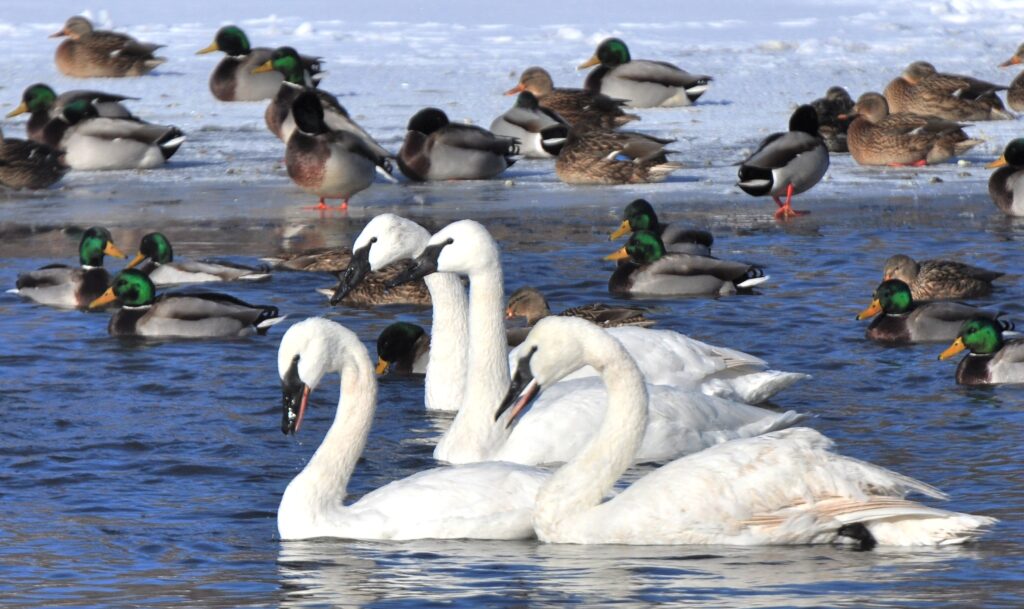
Following the devastating statewide loss of wild birds that occurred last winter, highly pathogenic avian influenza [commonly referred to as Bird Flu] is once again sweeping through Iowa’s wintering bird populations. Waterfowl are most affected by the deadly virus. This year, the most notable die offs are occurring across the northern and western portions of the state where crowding and weather-related stress on wintering waterfowl is greatest. From southwest Iowa to Lake Okoboji to Clear Lake, Mason City, and beyond, sick or dying birds have become an increasingly common sight during the past several days.

Although Canada geese are the most impacted species; sick or dead trumpeter swans, snow geese, red-tailed hawks, American crows, and immature bald eagles have also been reported. Affected birds typically appear uncoordinated, may swim in circles, are lethargic, and may be reluctant or unable to fly when approached. Although the CDC considers the [human] risk of contracting the virus in the U.S. to be extremely low, interactions with sick birds is discouraged.
Although wintering bald eagles are actively feeding on infected goose carcasses, only limited mortality has been documented, according to State Wildlife Veterinarian, Rachel Ruden.
Young-of-the-year eagles appear to be most susceptible to the virus. By contrast, many mature bald eagles have antibodies against the virus based on birds that have been tested after dying of unrelated causes, said Ruden. A recent [2023] study conducted at the University of Minnesota’s Raptor Center revealed that more than 50 percent of the eagles examined had specific neutralizing antibodies for avian influenza. Other raptors appear to lack effective immunity.


 Susan Judkins Josten
 Rudi Roeslein
 Elyssa McFarland
 Mark Langgin
 Adam Janke
 Joe Henry
 Sue Wilkinson
 Tom Cope
 Kristin Ashenbrenner
 Joe Wilkinson
 Dr. Tammy Mildenstein
 Sean McMahon