
Photography courtesy of Lowell Washburn, all rights reserved.
The 2022 fall hunting season was shaping up to be one of the best since I began flying large falcons during the 1980s. Pheasant populations were strong and migrating waterfowl were becoming increasingly abundant. Best of all, I was holding two stunningly beautiful, adult female peregrine falcons on my federal falconry permit. Although I had flown more than a dozen peregrines over the years, this was the first time I had possessed two trained females at the same time.
Renowned for their blinding speed and unsurpassed courage, peregrines are simply the Top Guns of the bird world. When given a fair shot, the legendary “duck hawk” is capable of taking game up to, and including, rooster pheasants, prairie grouse and drake mallards. Feeling like the falconer equivalent of of a multi-billionaire, I was locked and loaded, armed and dangerous — sitting on top of the world. Gamebirds beware!
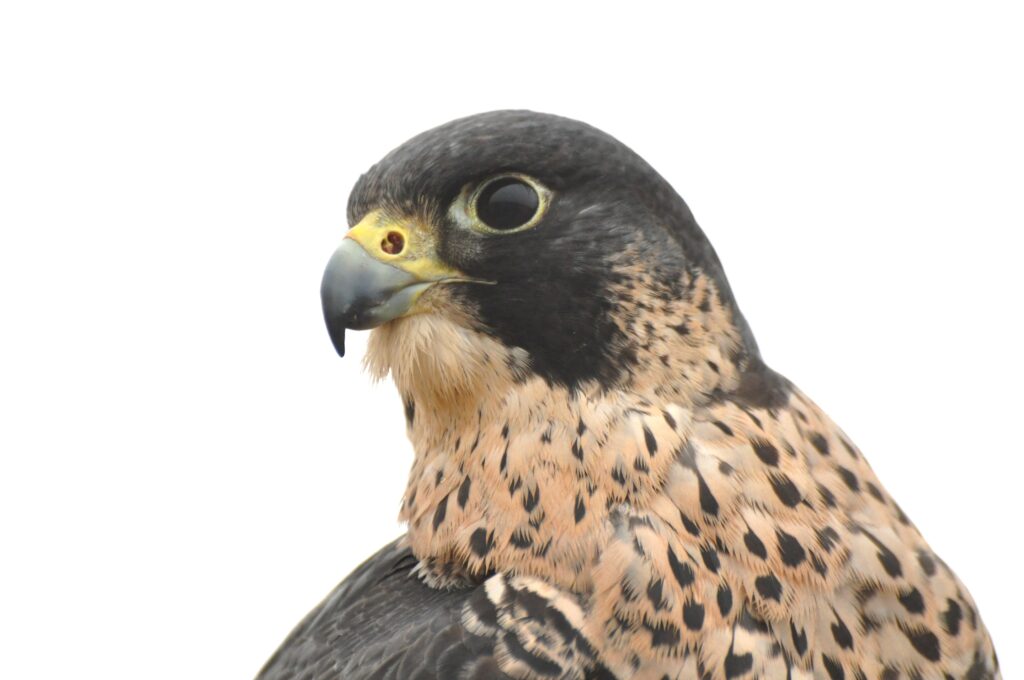
At then it all came tumbling down. The first hint of trouble came one afternoon when my youngest bird – now a two-year-old — appeared to be a bit “off color”, lacking her usual energy and ravenous appetite. In less than 24 hours she was dead. Her last meals had been wild duck. I suspected that one or more of those ducks had been a carrier of avian influenza [bird flu] – a deadly virus that was being reported among waterfowl with increasing frequency.
Both of my peregrines had eaten wild duck, and a couple of days later, my second falcon began exhibiting those same symptoms. Within hours, she too had perished, a second victim of the deadly virus. I was in shock and couldn’t believe that a disease could exact its toll so rapidly. Strong and powerful falcons one day; and then dead in a matter of hours. As I dealt with the loss of those beautiful falcons, I also began to wonder what impact the bird flu might be having on Iowa’s recently restored populations of wild peregrines.
By the mid-1960’s, Iowa peregrine populations had completely disappeared following cataclysmic crashes due to the widespread, post World War II, use of DDT pesticides. But following a decade long [1989 – 2000] recovery program, fueled by the release of captive reared fledgling falcons, a sustainable peregrine population has been reestablished. The thought of losing the recovering population of these spectacular birds for a second time is, well, is unthinkable.
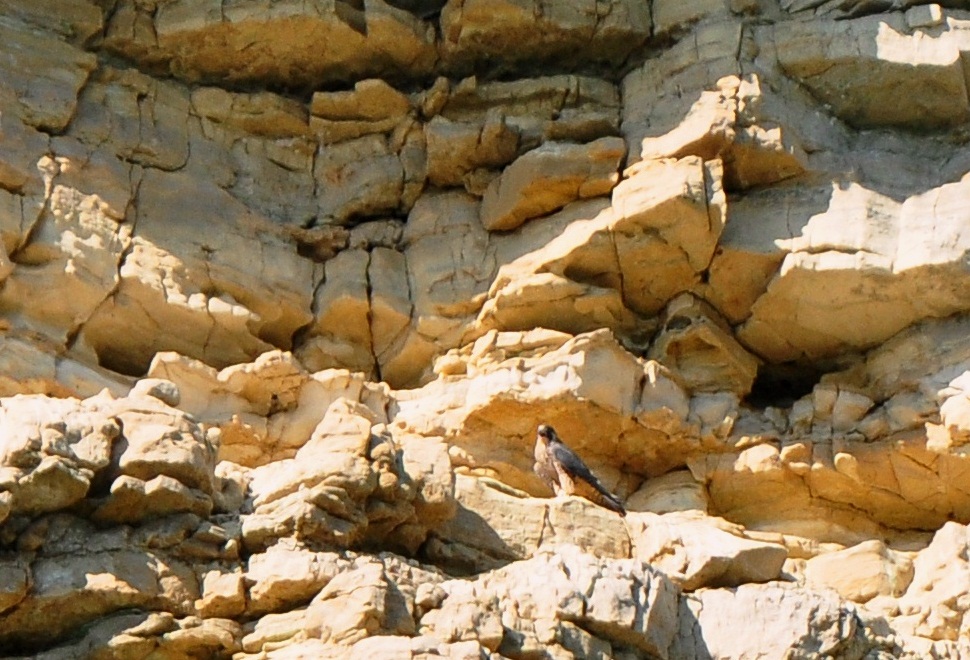
Migratory waterfowl and shorebirds are among the primary vectors of avian influenza, which has currently become a global threat to both wild and domestic birdlife. Unfortunately, ducks and shorebirds are an important food source for wild peregrines – especially for North American birds that winter in coastal South America.
Avian influenza is currently credited with peregrine declines in eleven countries, including the United States. In the U.S., as elsewhere, birds nesting in coastal regions – New Jersey, Virginia, California, and Washington state – have shown the most dramatic declines. By contrast, peregrines nesting in more urban environments – skyscrapers, bridges, power plant towers – are maintaining more stable populations. Biologists theorize that while coastal falcons prey heavily on shorebirds and small ducks, urban peregrines are more dependent on things like pigeons and starlings – prey items that are less likely to be infected with influenza virus.
In Iowa, a total of 20 peregrine nests were monitored by volunteer wildlife enthusiasts during 2025. Nineteen of those nests were active. Thirteen nests were reported as successful, producing 28 young. Two nests failed; four nests had unknown outcomes and may have produced additional young. According to DNR wildlife biologists, the number of 2025 nesting territories and reproductive success was similar to the past four years indicating populations are remaining stable.
In Iowa, peregrine falcons utilize a contrasting mix of nesting habitats. While breeding pairs have been successfully recolonizing historic cliff ledge nest sites on the Upper Mississippi River, other pairs have adapted to rearing their young on urban structures such as the Dubuque County courthouse and the Iowa state capital building.
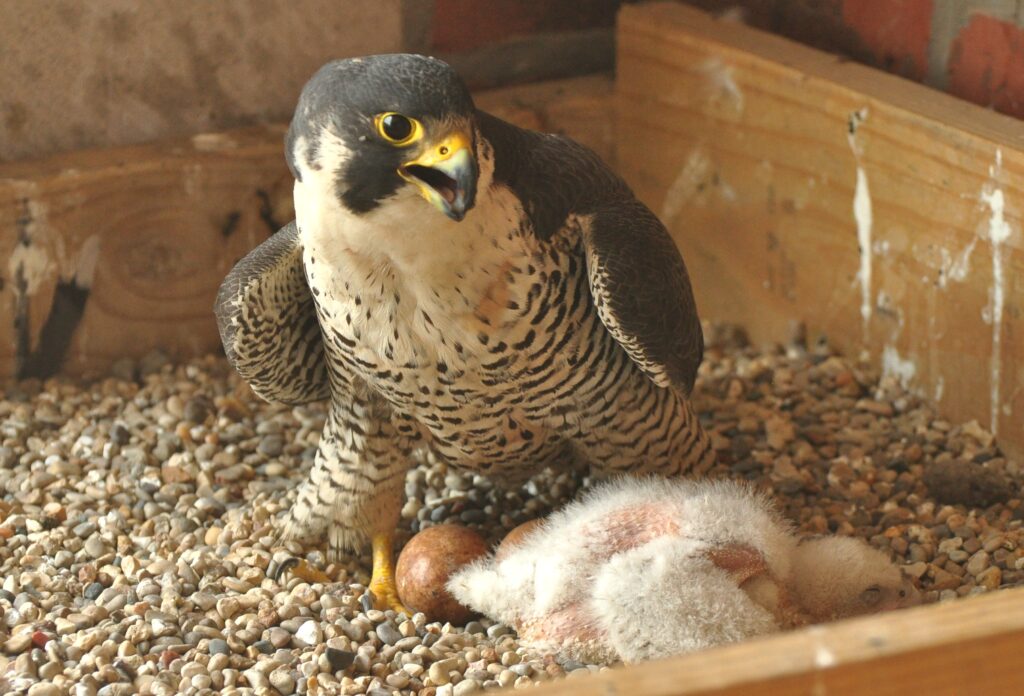
Although one northbound [Iowa banded] peregrine was captured [in March] south of Mexico City, little is known about where Iowa peregrines actually spend the winter. Wherever they go, it appears as if their survival may be greater than birds that spend the winter hunting along South American coastlines.
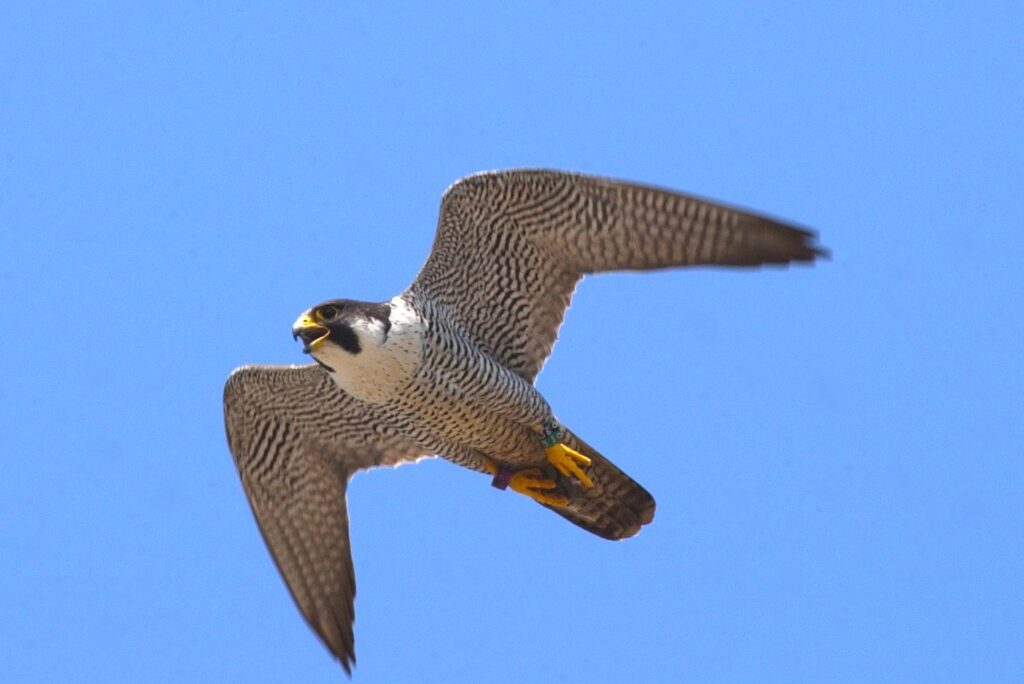
Although four Iowa peregrines were known to have died from avian influenza during 2025, the actual number was probably greater. That is alarming. And although the known mortality may not be enough to derail the peregrine’s ongoing recovery, it is certainly cause for concern – especially when considering the dramatic population declines that are occurring elsewhere.

 Susan Judkins Josten
 Rudi Roeslein
 Elyssa McFarland
 Mark Langgin
 Adam Janke
 Joe Henry
 Sue Wilkinson
 Tom Cope
 Kristin Ashenbrenner
 Joe Wilkinson
 Dr. Tammy Mildenstein
 Sean McMahon