
Photography courtesy of Lowell Washburn, all rights reserved.
If you’ve not yet seen or heard a big old bullfrog booming from the edge of your favorite fishing hole or duck pond, hold on. The time is coming when you will. Whether or not you view that statement as good news or bad is largely a matter of personal perspective.
A native inhabitant of Mississippi River backwaters, the foot-long American bullfrog is Iowa’s largest frog. If a bullfrog can escape predators long enough to reach its prime, it can potentially attain weights exceeding one pound. Now that’s a big frog anywhere in the world.
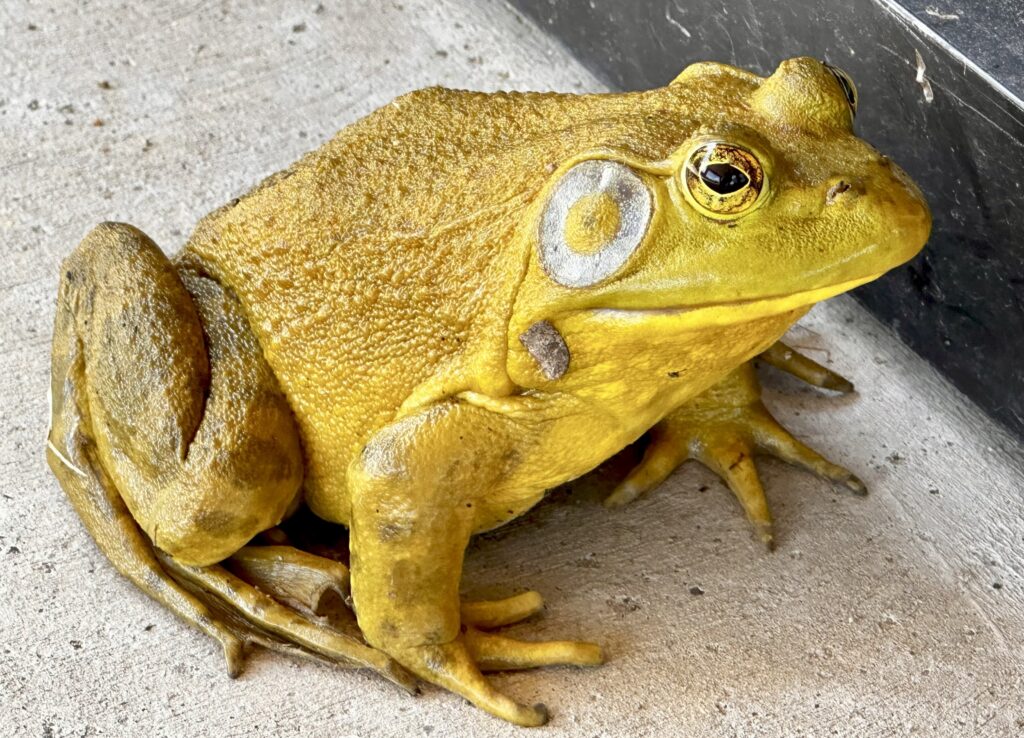
Although famous for their booming calls and spectacular leaps, bullfrogs are perhaps best known for their much sought after, ginormous rear legs. Whether prepared in a fish camp skillet or served atop fine China in big city restaurants, frog legs are the universal crowd pleaser – an entrée that never fails to deliver superb dining pleasure.
In Iowa, as elsewhere, the human desire to produce more frog legs in more places has led to a mix of joy and sorrow. Both emotions are the result of bullfrog introductions – intentional relocations aimed at establishing new populations. People have been moving bullfrogs westward from their Mississippi River habitats for at least the past 100 years. The reason is pretty straight forward. More frogs mean more frog legs. Simple.
But there is also a second, more negative, aspect to bullfrog transplants. The reason many folks cringe over the introduction of bullfrogs into new areas is a bit more complex. The species’ enormous size – the thing that makes bullfrogs so popular in the first place – is also a reason for concern. With a maw to match its size, an adult bullfrog will eat just about anything it can cram into its mouth. In addition to insects, crayfish and other invertebrates, the bullfrog’s daily menu may also include such oddities as rodents, snakes, lizards, hatchling turtles, salamanders and fledgling baby birds. No real problem so far. With the exception of certain turtles, most of those populations can easily withstand reasonable predation. But when bullfrogs begin eating or otherwise outcompeting other amphibians – especially those species already in decline — their predation can become a crisis.
During the breeding season, male bullfrogs use their booming calls to attract females. When compared to other species, male bullfrogs are highly territorial. If another male invades an existing territory, a vigorous fight will determine who retains the real estate. But if a lesser species – like a leopard frog, chorus frog, etc. — invades the territory, it may be eaten. There’s more.
A female bullfrog may produce upwards of 20,000 eggs in a single season. For native species competing within the same breeding ponds and laying far fewer eggs, this alone may present an insurmountable dilemma. Once they hatch, it takes bullfrog tadpoles two years to mature. But once they do, their lifelong feeding binge begins. Native amphibians beware. For endangered species already at the tipping point, introduced bullfrogs have the potential for providing a fast track to extinction. With expanding populations firmly established as far away as California, biodiversity scientists currently list bullfrogs as one of “the most dangerous invasive species in the Western U.S.”, according to Vox environmental correspondent, Benj Jones.
Bullfrogs are also carriers of the deadly chytrid [Bd] fungus. Chytrid has decimated amphibian populations worldwide and is credited with the decline [or complete extinction] of over 200 species of frogs and other amphibians, according to the College of Veterinary Medicine’s NYS Wildlife Health Program. Bullfrogs may be unaffected and remain completely healthy while spreading the disease to other species. Chytrid fungus is harmless to humans.
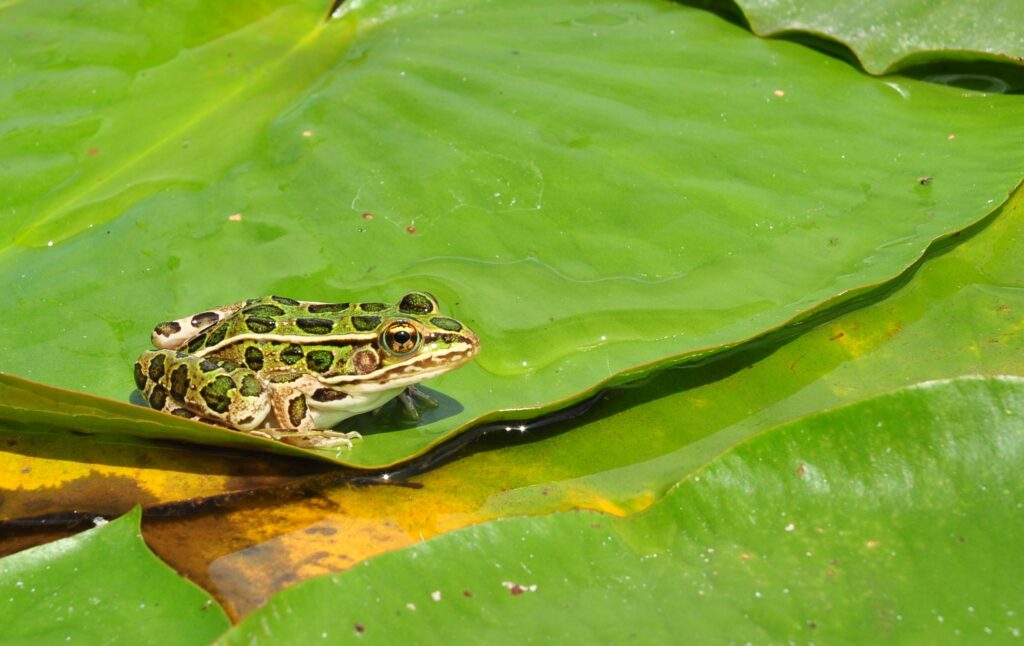
In Iowa, the bullfrog lives in two worlds. It is both a native as well as an invasive species. Native because bullfrogs occur here naturally; invasive because humans – despite the potential threat to other amphibians — have intentionally expanded the species’ range. Although there are still gaps in that range, remaining vacancies are being filled, sometimes rapidly, as the species continues to connect the dots. With its expansion nearly complete, the bullfrog is currently regarded as a statewide inhabitant of Iowa wetlands.
Although populations exist to the east and north of Cerro Gordo County where I live, I have never heard or seen a bullfrog anywhere in the county’s wetland-rich landscape. That is, until this summer. Following a four-year drought, water – and plenty of it — has returned to northern Iowa. Marshes and lakes are full and running over. Amazingly, bullfrogs suddenly seem to be everywhere. This summer, I’ve heard multiple males calling from the concealment of shoreline vegetation at Clear Lake – Cerro Gordo’s largest water body. Jason Reynolds, my pastor at the Clear Lake Baptist Church, snapped a photo of an adult male bullfrog sitting at the church entrance. Elsewhere in the county, I’ve heard bullfrogs calling from the cattail fringe of remote, walk-in prairie potholes – isolated habitats that didn’t contain a single drop of water last fall. The bullfrog’s sudden, countywide presence is astonishing.
I’ve read that bullfrogs – especially younger males — may travel considerable distances to establish new territories. That’s probably what’s happening in Cerro Gordo. And although current populations are low, I’m guessing that it won’t be long until local residents begin sampling home-grown frog legs.
Because of the negatives already stated, I remain wholeheartedly opposed to bullfrog relocations. The bad always outweighs the good. Given the right set of circumstances, bullfrogs become nothing less than amphibial wrecking balls.
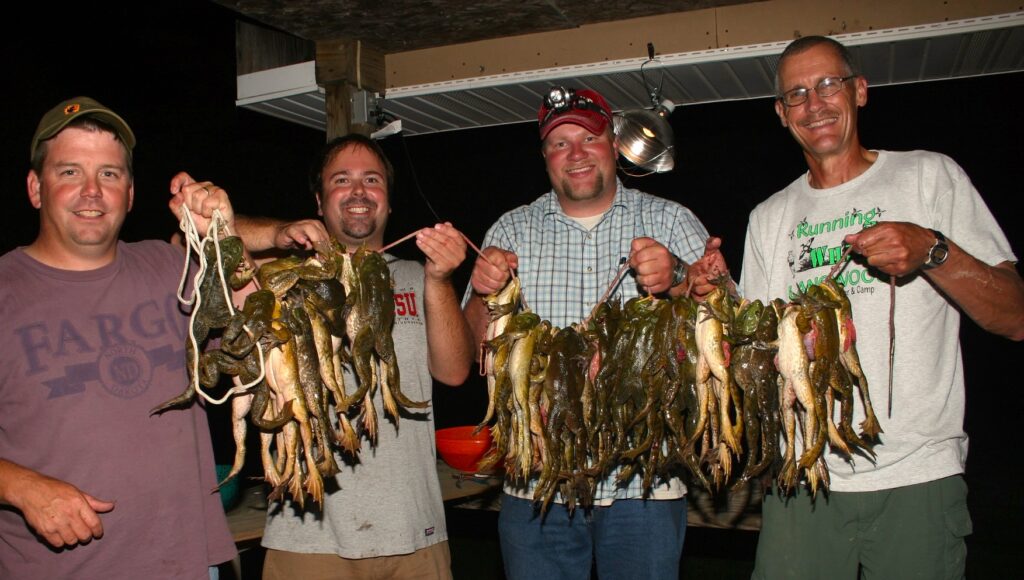
Having said that, I’ll also admit that I absolutely love eating frog legs. Whether fried, broiled, baked, or cooked on a stick, frog legs send my taste buds into orbit. I’ve enjoyed some good frog feeds over the years. Among the most memorable was the year waterfowl biologist, Guy Zenner and I trailered our duck boats to southeastern Iowa to hunt ducks on the Mississippi River with our mutual friend Bill Ohde.
Arriving at Ohde’s home well after dark, Bill threw open the door and invited us in for a late supper. We began our meal with some fresh caught, Mississippi backwater appetizers which, in this case, was a stack of frog legs the likes of which I had never seen. As the meal progressed, the cleaned bones were tossed unto a platter placed in the center of the table. The final result was a shiny pyramid of bones that made me wonder if there were any frogs left on the river. Once the preliminaries were complete, Bill – who is an accomplished chef — served up generous portions ‘Pheasant Ohde’. Developed by Bill himself, ‘Pheasant Ohde’ is an epicurean masterpiece — the finest gamebird dish to ever reach a hungry hunter’s lips. All in all, it was quite a feast, which may be the reason I spent a good part of the next morning snoozing in my duck boat when I should have been scanning the skies.
 Susan Judkins Josten
 Rudi Roeslein
 Elyssa McFarland
 Mark Langgin
 Adam Janke
 Joe Henry
 Sue Wilkinson
 Tom Cope
 Kristin Ashenbrenner
 Joe Wilkinson
 Dr. Tammy Mildenstein
 Sean McMahon