
Photography courtesy of Lowell Washburn, all rights reserved.
Following a summer of secretive seclusion, this year’s crop of baby sandhill cranes is currently on display — in the open and on the wing. Gearing up for their first migration, young cranes [more properly referred to as colts] are enjoying the thrill of riding the wind with their newly acquired powers of flight. But it’s not all games, and there’s serious business as well. School is in session as parent birds lead youngsters on daily excursions to new marsh and pastureland habitats where adults are teaching their offspring the critical skills needed for survival in the wild – skills that include locating and capturing such protein rich delicacies as frogs, crayfish, voles, and snakes.
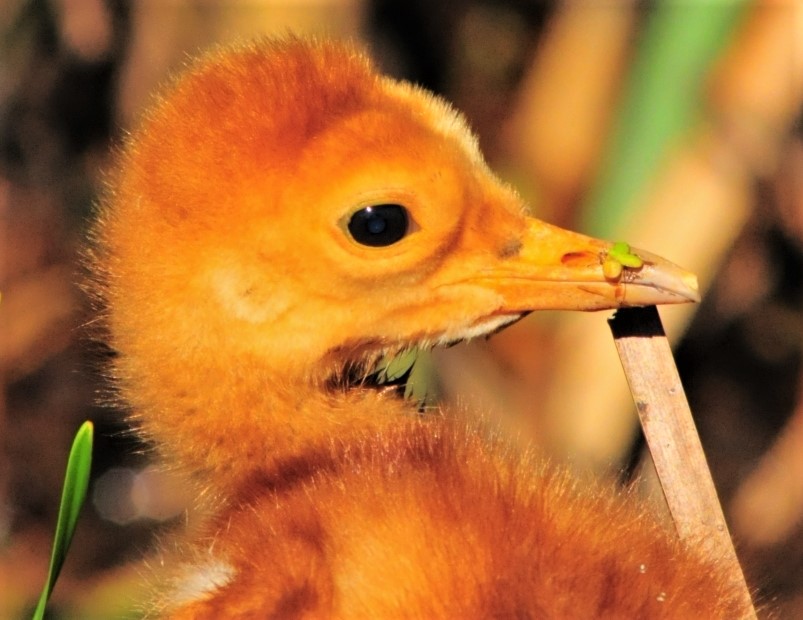
By the time cold weather sets in a couple months from now, young cranes will have gained the strength needed to follow their parents to distant southern wetlands. Once they arrive on those milder climes, families will stay together for the remainder of the winter. At the approach of the spring nesting season, the youngsters birds will accompany their parents north again. Once they arrive on the nesting grounds, the young birds will strike out on their own. Most cranes don’t begin nesting until their fifth or sixth year. Once a mate is chosen, the bond remains for life. Although cranes typically raise only one [and sometimes two] colts per season, established pairs have amazing longevity and may successfully reproduce for more than thirty years.
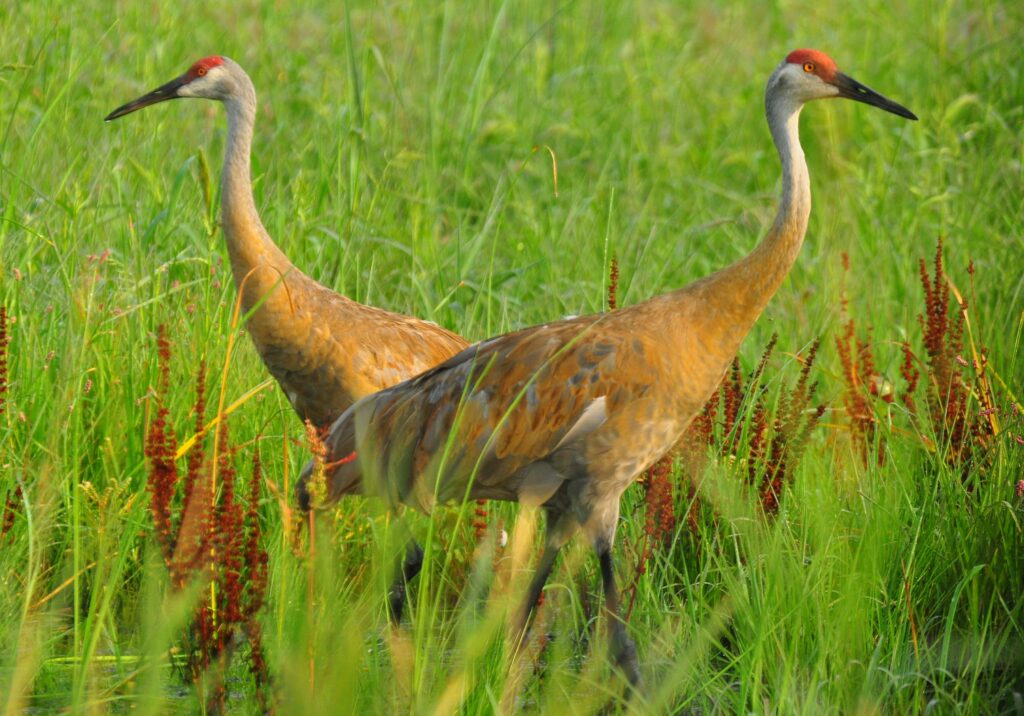
Wild cranes were once common inhabitants of Iowa’s prairie wetland complex. During the 1800s, crane flocks containing several hundred, and even thousands of birds, were reported on the marshes of northern Iowa’s Winnebago and Hancock counties. But following the arrival of European settlers, crane numbers began a rapid decline. Relentlessly hunted for food and feathers, pressured by wholesale drainage, and plagued by the growing popularity of wild bird egg collections; crane flocks became a rare sight before disappearing completely. The state’s last known nesting occurred on a marsh located near Hancock County’s Eagle Lake in May of 1894. This final attempt was unsuccessful when egg collectors discovered and raided the nest. Nearly a century would pass before a crane pair would successfully nest anywhere in Iowa.
But although wild cranes had completely vanished from Iowa, fragile populations managed to survive in undeveloped reaches of Wisconsin, Minnesota, and Michigan. After decades of struggling to maintain their isolated populations, the mid-continent flocks began to gain in numbers. As the increase continued, potential breeders began to spill into new territories. Iowa became the direct beneficiary of this expansion when, in 1992, two successful crane nests were documented at east central Iowa’s Otter Creek Wildlife Area.
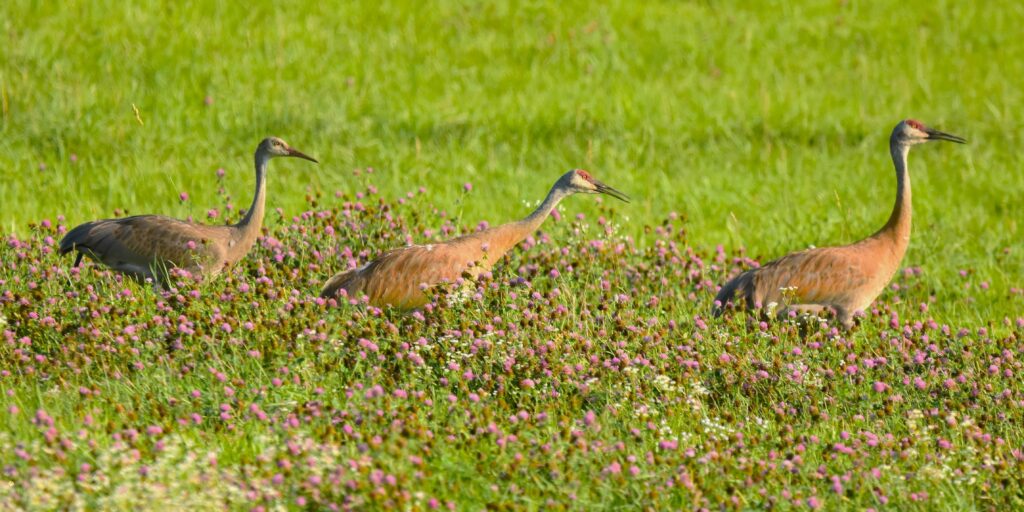
Eighteen years later, and more than a full century since their disappearance, sandhill cranes returned to Northern Iowa’s Cerro Gordo County in 2010 where a single colt was produced from at a nest located on the 992-acre Ventura Marsh.
Although cranes remain one of Iowa’s rarest nesting bird species, they are continuing to expand their range across the state’s public wetlands. More adaptable to human activity than their ancestors, sandhill cranes are successfully nesting in at least 35 of Iowa’s 99 counties.
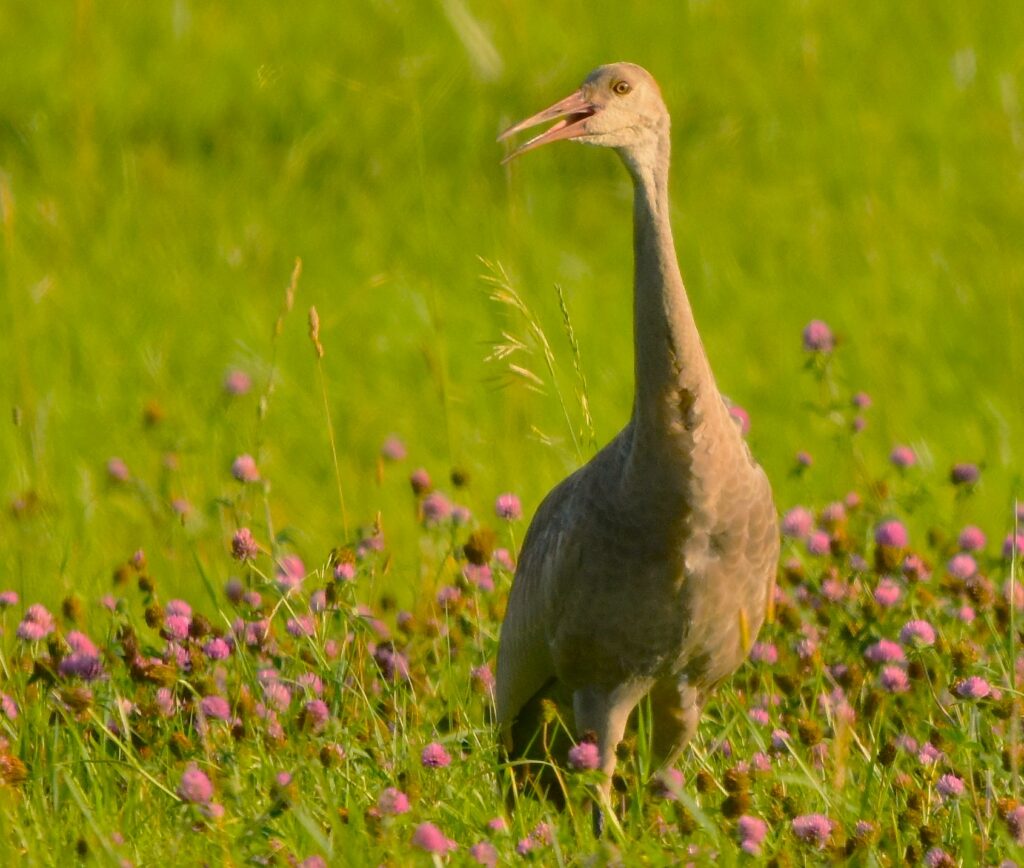
The opportunities for Iowans view this iconic native bird species has never been greater in our lifetimes – and that statement holds true for anyone reading this page.


 Craig Parker
 Ann Wolf
 Thomas Rinehart
 Susan Judkins Josten
 Rudi Roeslein
 Elyssa McFarland
 Mark Langgin
 Adam Janke
 Joe Henry
 Sue Wilkinson
 Tom Cope
 Kristin Ashenbrenner
 Joe Wilkinson
 Dr. Tammy Mildenstein
 Sean McMahon