DarkSky Iowa
Proudly Sponsored by IWF
DarkSky Iowa, proudly sponsored by the Iowa Wildlife Federation, is focused on reducing light pollution and protecting wildlife through responsible outdoor lighting across Iowa.
Protecting Iowa's Wildlife After Dark
Darkness is part of wildlife habitat.
Birds migrate through the night. Bats forage after sunset. Moths and other insects pollinate plants and provide food for birds, fish, amphibians, and other wildlife. Many species depend on natural cycles of light and darkness to feed, reproduce, navigate, and survive.
Iowa Wildlife Federation is a proud supporter of DarkSky Iowa, focused on reducing unnecessary artificial light at night and protecting the natural darkness that wildlife depends on.
The goal is simple: help Iowans use outdoor lighting more thoughtfully while preserving safety, visibility, and the character of our communities.
What is Light Pollution?
Light pollution occurs when artificial light is brighter than needed, poorly directed, used when it is unnecessary, or allowed to spill beyond the area it is intended to illuminate.
It can take several forms:
- Skyglow: The brightening of the night sky over communities
- Glare: Excessive brightness that can make seeing more difficult
- Light trespass: Light spilling onto neighboring property or natural areas
- Overlighting: Using more light than a task requires
Why Dark Skies Matter
For wildlife, artificial light can change nighttime habitat.
Many migratory birds travel after sunset, and artificial light can attract them toward developed areas and increase their exposure to buildings and glass. BirdCast recommends reducing nonessential lighting during migration because artificial light can disrupt migrating birds.
Artificial light can also affect insects and nocturnal pollinators. Research published in Nature found that artificial nighttime lighting reduced nocturnal visits to plants by 62% in the study area and affected plant reproductive success.
Bats provide another connection. Insect-eating bats consume crop and forest pests, providing substantial value to agriculture. Some bat species also avoid illuminated areas, making darkness an important part of nighttime habitat.
Protecting Iowa's Wildlife After Dark
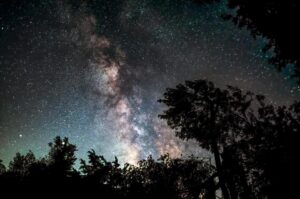
Darkness is part of wildlife habitat.
Birds migrate through the night. Bats forage after sunset. Moths and other insects pollinate plants and provide food for birds, fish, amphibians, and other wildlife. Many species depend on natural cycles of light and darkness to feed, reproduce, navigate, and survive.
Iowa Wildlife Federation is a proud supporter of DarkSky Iowa, focused on reducing unnecessary artificial light at night and protecting the natural darkness that wildlife depends on.
The goal is simple: help Iowans use outdoor lighting more thoughtfully while preserving safety, visibility, and the character of our communities.
Protecting that experience can go hand in hand with protecting wildlife.
Better Lighting is the Solution
Protecting dark skies does not require eliminating outdoor lighting.
Responsible lighting provides the light people need while reducing unnecessary glare, spill, brightness, and skyglow.
DarkSky International and the Illuminating Engineering Society recommend five principles for responsible outdoor lighting:
- Useful: Use light only when it serves a purpose.
- Targeted: Direct light only where it is needed.
- Low level: Use no more brightness than necessary.
- Controlled: Use timers, dimmers, and motion controls where appropriate.
- Warm-colored: Limit unnecessary blue-rich light.
A shielded fixture, lower-output lamp, timer, motion sensor, or simple change in aim can sometimes solve a lighting problem without replacing the entire fixture.
What DarkSky Iowa Does
DarkSky Iowa works through education, collaboration, and practical solutions.
The program focuses on educating Iowans about light pollution and wildlife, promoting responsible outdoor lighting, protecting darker conditions around wildlife habitat, supporting bird-friendly lighting during migration, helping communities address glare and light trespass, and working with landowners, conservation organizations, businesses, utilities, and local governments.
Start With Your Own Outdoor Lighting
Take a walk around your property after dark.
Look at each outdoor light and ask:
- Do I need it?
- Is it brighter than necessary?
- Is the light staying on my property?
- Is it on when nobody needs it?
- Could I shield, dim, redirect, or control it?
Improving outdoor lighting does not have to be complicated.
Help Protect Iowa After Dark
Iowa has already lost much of the prairie, wetland, and other native habitat that once covered the state. We still have many places where nighttime darkness remains part of the landscape.
When we protect Iowa’s wildlife habitat, that responsibility continues after sunset.
Birds are migrating overhead. Bats are hunting. Insects are pollinating plants and sustaining food webs.
Darkness is habitat. Help us protect it. Support DarkSky Iowa.
 Craig Parker
 Ann Wolf
 Thomas Rinehart
 Susan Judkins Josten
 Rudi Roeslein
 Elyssa McFarland
 Mark Langgin
 Adam Janke
 Joe Henry
 Sue Wilkinson
 Tom Cope
 Kristin Ashenbrenner
 Joe Wilkinson
 Dr. Tammy Mildenstein
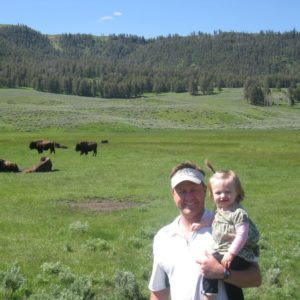 Sean McMahon