Aldo Leopold (Burlington-born Conservationist):
“A thing is right only when it tends to preserve the integrity, stability and beauty of the community; and the community includes the soil, water, fauna and flora, as well as the people.” — A Sand County Almanac (1949)
The Case for Supporting Wildlife & Water
A message from Ryan Smith, Executive Director of the Iowa Wildlife Federation.
I think it is appropriate to share wisdom from a fellow Iowan and conservationist. The quote above from Aldo Leopold seems to answer Iowans concerns about our current water situation. How to take care of our natural resources, including water, is generational. Luna Leopold, son of Aldo, said, “Water is the most critical resource issue of our lifetime and children’s lifetime. The health of our waters is the principal measure of how we live on the land.”
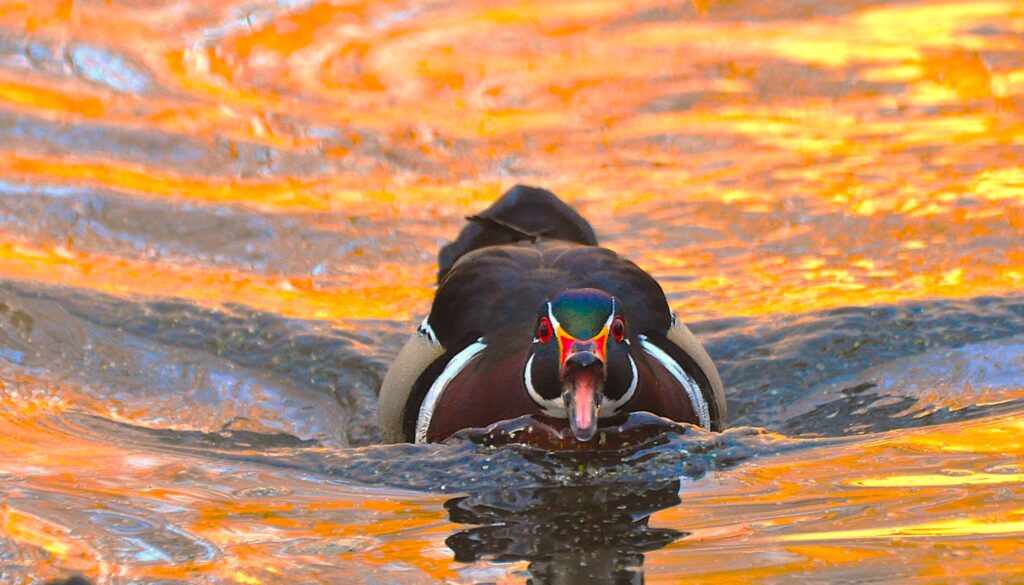
The State of Iowa manages fish and wildlife under the Public Trust Doctrine – which means these animals are owned by no one and held in trust by the government for current and future generations. One challenge in upholding that Doctrine is that roughly 98% of Iowa’s land is privately owned. That means how everyday people – especially private landowners – treat our water and land has the most influence on our shared resources. The state and the people must work together to support fish and wildlife.
Iowans care deeply about protecting our water and wildlife. However, we have lost approximately 90% of our original wetlands and over 99.9% of our native prairie to agriculture and development. Over the past 50-75 years, as we’ve spread more chemicals on farm fields, lost more habitat, and shifted more investment away from local economies, we’ve also lost connections to Iowa’s most precious natural resources.
Iowans and our wildlife are bearing the costs of our management decisions, and now we face a critical moment. Our water quality and habitat challenges are not new. They are the product of several decades of land use and policy decisions. However, the record nitrate concentrations in our rivers and accelerated water quality degradation in recent years illustrates the need for urgent action to safeguard our wildlife and water quality for future generations.
Two components that are essential to this conversation are the Iowa Nutrient Reduction Strategy and the Iowa Natural Resources and Outdoor Recreation Trust Fund. The former illustrates our shared understanding of what needs to be done to improve our water quality through agricultural and conservation practices. The latter is a solution to provide sustainable funding for programs, practices, and administration that will improve our water quality.
We know we must work together and make wise choices to change our course. Iowa produced some of America’s greatest conservation champions, including Aldo Leopold and Ding Darling. These champions recognized the challenges around them and made a commitment to action. Like them, we must act so the next generation of Iowans is inspired to care for our wildlife and our neighbors.
This document serves as a conversation starter. The ideas and issues discussed are not a policy prescription but rather a few points of entry to potential solutions and measurable outcomes. The Iowa Wildlife Federation is engaging candidates, regardless of party affiliation, to keep focus on Iowa’s water problems and wildlife habitat challenges, to establish a framework for continuous improvement so our communities, our children, our natural resources, and our wildlife might thrive in perpetuity.
Thank you for your consideration.
Sincerely,
Ryan Smith, Executive Director
Water Quality
Iowans are increasingly concerned about the quality of our water – from turning on the tap to deciding whether our waters are safe to swim in or eat fish from, water quality is a growing concern. Iowa’s economy and communities were built on how the water flows. Settlers changed the landscape from tall grass prairie, wetlands, and meandering rivers by draining the soil and artificially lowered water levels to access the most productive soils in the world. Iowa ranks among the states with the greatest extent of agricultural drainage tile. Only 11% of our original wetland habitat remains, with only California and Ohio having lost a greater percentage. The changes we chose to implement to control water systems significantly impacted how our landscape absorbs the impacts of quicker shifts between flooding and drought.
Additionally, we have developed incredibly productive agricultural systems through research and practices to improve efficiency and yield. When we become aware of how inputs and practices negatively impact our health and ability to thrive, it is up to us to make changes accordingly. Not to place blame but rather to create solutions.
The Iowa Wildlife Federation encourages our state leaders to commit to improving our water and soil health by working together. We need our leaders to choose wise solutions, using up-to-date science and data, to create an Iowa where people and wildlife can prosper and thrive. Getting our priorities back in order will require all of us; urban and rural communities, farmers, hunters and anglers, outdoor enthusiasts, business owners, landowners, corporations, and elected officials. Iowa’s future will require commitment and accountability from us all.
Core Considerations
Transparency & Fairness
Every Iowan deserves reliable information about the safety of the water they drink and the waters they use. Whether or not their water is safe to drink, safe for swimming and paddling, and whether fish are safe to eat. Families and local communities are already experiencing nutrient contamination, harmful algal blooms, and disease; and bearing the high financial costs of treating drinking water. Information needed to address pollution should be publicly available on reliably funded platforms.
Additionally, we must consider how we arrived at this critical situation. We must have the courage to accept that certain policies and practices may have become outdated, and that some systems are perpetuating our water problems. We must also acknowledge the importance of agriculture to Iowa’s economy, as well as the complexity of our current agricultural system. Growing up in Iowa does not necessarily mean that one automatically understands how these systems work. It is our responsibility to follow the facts, learn, and implement solutions.
Rebalancing Priorities & Shifting Financial Incentives
Iowa is caught in a system in which the needs of local human and wildlife communities can be overshadowed by competing economic interests. Too often, those behaviors that cause harm are incentivized through tax exemptions and funding programs. We need to invest in new and expanded opportunities to incentivize restoring wildlife habitat, improving water quality, and reducing exposure to harmful chemicals.
More funding should be directed toward voluntary programs for restoring habitat and improving water quality. However, the evidence is clear that these programs, at their current funding levels, are not sufficient to create change at the pace and scale necessary to address threats to wildlife and human health. We need to find solutions that improve wildlife habitat and water while providing financial support to farmers and landowners as they transition to improved management practices that result in positive outcomes. We need to ensure that the costs of change are shared among Iowa taxpayers, landowners, and businesses., landowners, and businesses. The health of our natural resources depends on the responsibility and accountability of all Iowans.
Support Practices that benefit water and wildlife
Improvements to Iowa’s water will occur when we choose to change our relationship with water, development, and habitat. Here are some examples of practices that can be employed to improve our water quality and provide beneficial habitat for wildlife. Each practice also includes wildlife species that benefit from specific practice adoption.
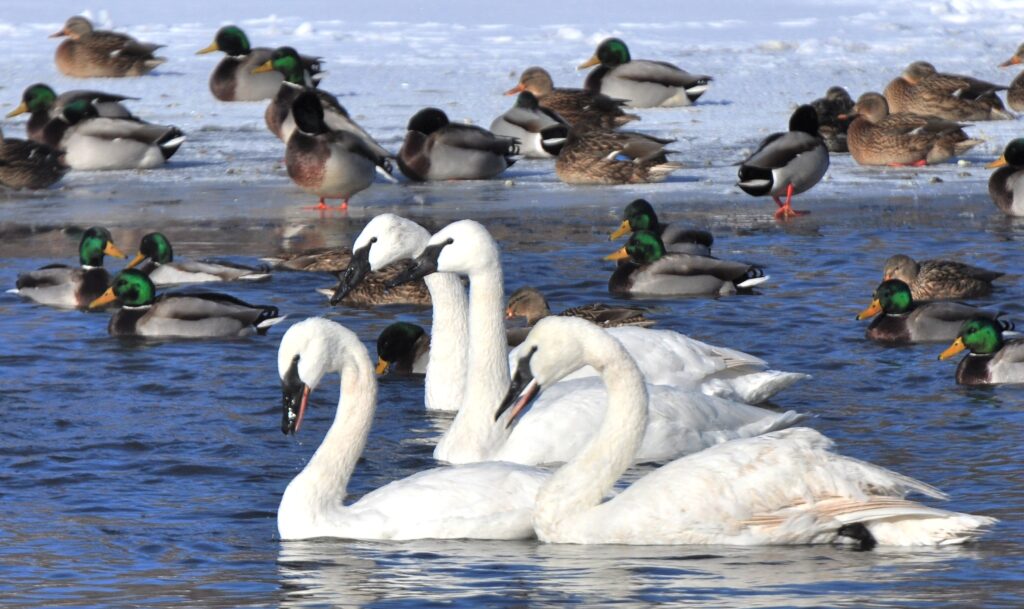
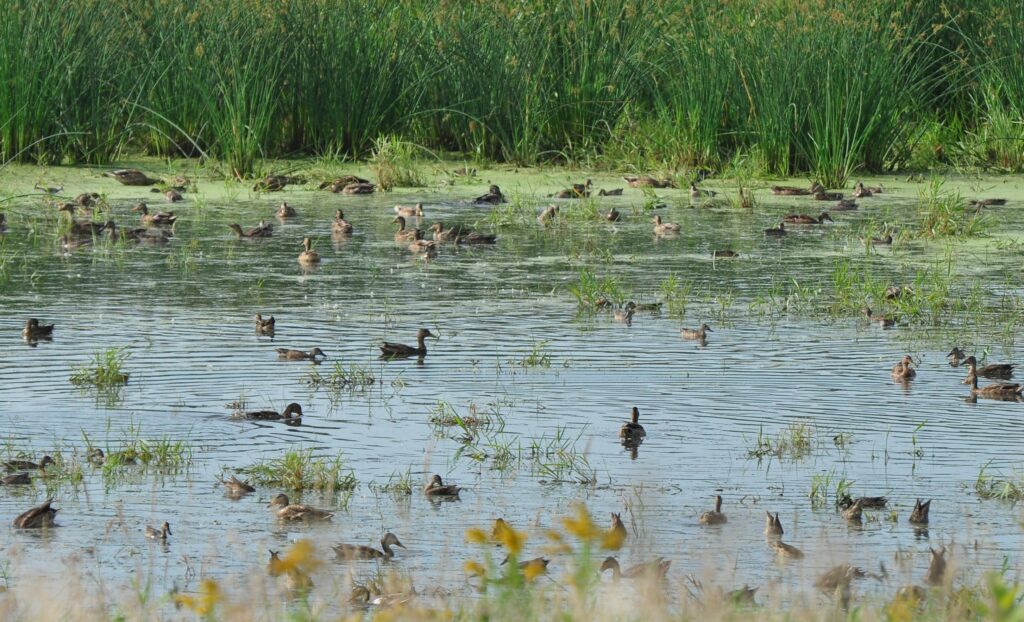
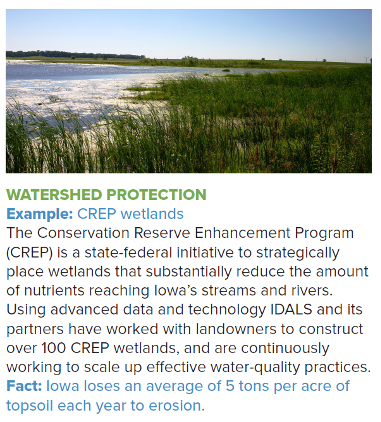
Wetlands Restorations: Describing transition areas where water covers the soil or sits at/near the surface for varying periods, supporting specialized plant and animal communities adapted to saturated conditions. Common examples of wetlands include swamps, marshes, bogs & fens, as well as areas that fill seasonally or temporarily with rainfall such as potholes and vernal pools. Wetlands provide natural denitrification. Wetlands also help with flood control and carbon storage. Additionally, wetlands provide wildlife habitat critical for breeding, feeding, and migratory resting grounds for birds, fish, and mammals. Species that benefit from wetlands include waterfowl (ducks, geese, swans, herons, etc.), raptors such as Bald Eagles and Red-Shouldered Hawks, mammals like muskrats, otters, mink, and beaver, as well as amphibians and reptiles including the endangered Blanding’s Turtle.
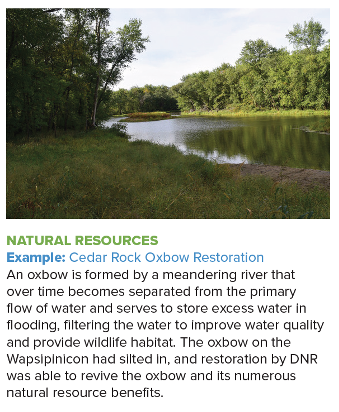
Oxbow Restoration: Oxbows, horseshoe-shaped wetlands formed when branches of a river are cut off from the main course. Oxbows are often created through the natural meandering of streams or when people channel rivers to accelerate surface drainage from the land. Oxbows provide habitat for fish, such as the Topeka Shiner (federally endangered), waterbirds, and pollinators such as the Monarch Butterfly.
Additional edge of field practices impacting water quality and providing wildlife habitat include:
Prairie Strips: Prairie strips involve planting a small percentage (typically 10%) of a crop field with native, deep-rooted prairie plants. Native prairie plants provide disproportionate benefits to a greater degree than other perennial vegetation types because of the diversity of native plant species incorporated, their deep and multilayered root systems, and their stiff stems that hold up in driving rain. According to Iowa State University, prairie strips can reduce soil loss and nutrient runoff as much as 95% while simultaneously increasing biodiversity. This is a win for water quality, farmers, and wildlife. Prairie strips create corridors for wildlife to navigate to and from larger natural areas. The wildlife species that benefit from prairie strips include: birds (quail, dickcissels, meadowlarks, and sparrows), pollinator insects (native bees, monarch and other butterflies), as well as reptiles, amphibians, and mammals.
Buffer Strips: Buffer strips are strips of vegetation planted between farm fields and sensitive areas such as rivers, streams, reservoirs, and roads. Buffers can include grasses, prairie, shrubs, or trees. Buffers slow down rainwater (surface) runoff, trap loose sediment, and can filer fertilizers and pesticides before they reach local water. Riparian buffers include trees and shrubs planted along riverbanks to shade water and stabilize soil. Filter strips are dense low-growing grasses placed at the bottom of sloped fields to catch runoff. Contour buffers are strips curved across hillsides to break up long slopes and slow down water. Native grasses and prairie have deep roots that protect soil from wind and water erosion, provide excellent wildlife habitat, and are ideal for areas that are difficult to farm or have low yield.
Saturated Buffers: Saturated Buffers are designed to reduce nitrate in agricultural tile drainage water before it reaches local streams. The water is directed into a lateral drainage tile installed parallel to a riparian buffer. Nitrates are removed by microbes as the water moves across the buffer. Additionally, plants in the buffer also remove nitrates through root uptake.
Bioreactors: A bioreactor is an engineered edge of field practice where a trench filled with a carbon source, usually woodchips. Tile drains from the field carry water from the plant root zone and divert some of the water into the bioreactor. Microorganisms on woodchips consume the nitrates in the water and expel it in a gas form.
Additional in-field practicesaffecting water quality and wildlife include:
Cover Crops: Cover crops are plants grown during the off-season to manage soil health, reduce soil erosion, improve water quality, and reduce weed pressure and herbicide use. Cover crops armor the soil to prevent erosion and have living roots. Some producers are also growing cover crops to supply seed. Many species of wildlife including white-tailed deer, grassland and upland game birds, small rodents and their predators, and pollinators benefit from the cover crops for vital off-season green forage and structural habitat.
No Till: No-till is a tillage system where no disturbance of the soil occurs prior to planting, except for the injection of liquid manure or anhydrous ammonia. In addition, all the residue from the previous crop remains on the soil’s surface to protect it from erosion. No-till often is used to achieve soil conservation requirements on highly erodible land, but it is becoming a more popular management practice among Iowa producers for the advantages it offers, and because of emerging technologies that address its limitations.
Strip Till: An alternative to No-Till in poorly drained soils, creates narrow-width tilled strips to increase early spring soil evaporation and soil temperature.
Improved Nutrient Stewardship (4Rs): Practices in the Iowa Nutrient Reduction Strategy developed by the Iowa Department of Land Stewardship, Iowa Department of Natural Resources, and Iowa State University. Implementing 4R nutrient stewardship practices optimizes the nutrients applied to maximize plant uptake and minimizes field losses. The 4Rs keep nutrients in the root zone and available when they are needed by crops. The 4Rs are: Right Source, Right Time, Right Rate, and Right Place.
IWiLL – Natural Resources & Outdoor Recreation Trust Fund
The Iowa Wildlife Federation is asking all candidates to commit to passing legislation that will activate IWiLL – Natural Resources & Outdoor Recreation Trust Fund.
Iowa’s Water and Land Legacy (IWILL) created for the purposes of “protecting and enhancing water quality and natural areas in this state including parks, trails, and fish and wildlife habitat, and conserving agricultural soils in this state.”
In 2010, Iowa voters approved the Iowa’s Water and Land Legacy (IWiLL) constitutional amendment to create the Natural Resources & Outdoor Recreation Trust Fund. The Trust Fund is a tool to provide dedicated, reliable funding for proven conservation practices, oversubscribed programs, and beloved outdoor amenities. But the legislature must increase the sales tax 3/8th of one cent to provide funding. Once approved funding will address the following:
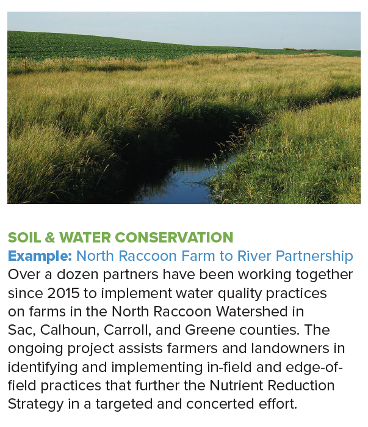
WATER QUALITY
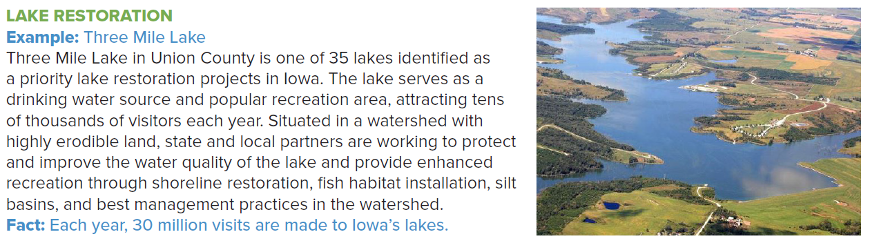
The majority of Trust Fund dollars can go toward water quality improvement projects, Including lake restoration, soil and water protection, and enhanced flood protection efforts. Up to two-thirds of the revenue is available for voluntary conservation projects outlined in the Nutrient Reduction Strategy.
PUBLIC HEALTH
The preservation and investments to protect Iowa’s green spaces, water and air quality can be keys to improving the health of current and future Iowans. Children’s risk for obesity can increase by as much as 60% if they don’t have access to nearby parks, sidewalks and other green space or recreational amenities.
ECONOMIC DEVELOPMENT
Investing in Iowa’s natural resources ensures that our communities benefit from ecotourism and Iowa companies can recruit and retain a quality workforce. In Iowa, outdoor recreation accounts for $8.7 billion in consumer spending, 83,000 jobs and $649 million in state and local tax revenue.
RURAL REVITALIZATION
Rural Iowa will benefit from the economic capital growth, tourism sales and conservation benefits the Trust Fund will provide. Quality of life initiatives, including outdoor recreation opportunities, will encourage our educated young Iowans to choose thriving rural communities to live, work and raise families.
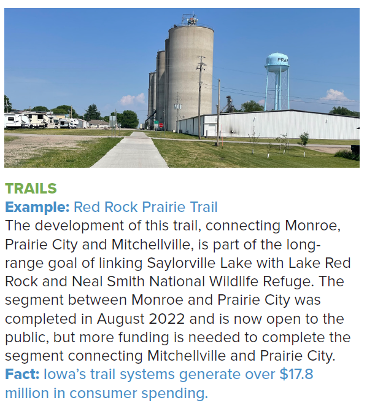
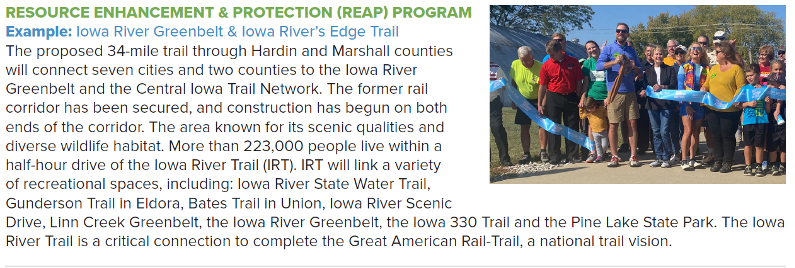
Examples of projects that would be supported by each part of the Natural Resources and Outdoor Recreation Trust Fund:
The Iowa Wildlife Federation urges legislators and the governor to include a sales tax increase in any future tax reform efforts and maintain the Trust Fund formula that was in place when Iowa voters passed the amendment.
 Craig Parker
 Ann Wolf
 Thomas Rinehart
 Susan Judkins Josten
 Rudi Roeslein
 Elyssa McFarland
 Mark Langgin
 Adam Janke
 Joe Henry
 Sue Wilkinson
 Tom Cope
 Kristin Ashenbrenner
 Joe Wilkinson
 Dr. Tammy Mildenstein
 Sean McMahon